ABSTRACT
Course recommender systems (CRSs) play an important role in helping students navigate large-scale online course platforms. However, effective course recommendation remains challenging due to sparse interaction data and the lack of explicit, learning-oriented representations on both the student and course sides. In this paper, we propose SORARec, a Student prOfile and couRse Attribute–aware Recommendation model that leverages large language models (LLMs) to enrich educational recommendations with learning-aware semantic information. Specifically, SORARec employs an LLM to infer structured student profiles and learning-relevant course attributes from historical enrollments and course metadata. These inferred semantics are encoded into dense embeddings and integrated with collaborative representations through a lightweight graph-based fusion mechanism. Unlike approaches that rely on LLMs for direct recommendation, SORARec uses LLMs only in an offline inference stage, preserving efficiency and scalability. Experiments on the real-world MOOC dataset demonstrate that SORARec consistently outperforms baselines under both general and cold-start settings. Ablation studies further confirm the complementary contributions of student profile and course attributes. The results indicate that jointly modeling student profiles and course attributes provides an effective and practical way to improve course recommendation performance in educational scenarios.
Keywords
1. INTRODUCTION
Massive Open Online Courses (MOOCs) and online learning platforms provide students with unprecedented access to diverse educational resources. However, the rapid growth of course catalogs also makes it increasingly difficult for students to identify courses that align with their backgrounds, interests, and learning goals [14]. Course recommender systems (CRSs) have therefore become a key component of modern educational platforms, supporting students in making informed enrollment decisions [16].
Despite substantial progress, effective course recommendation remains challenging. Unlike general-purpose recommender systems, CRSs must account for learning-oriented factors such as prior knowledge, learning objectives, and course difficulty, in addition to historical preferences. As a result, recommendation quality critically depends on the availability of informative student profiles and course attributes. In practice, however, such information is often missing. Most students enroll in only a small number of courses, leading to severe data sparsity and frequent cold-start situations [37, 17, 4]. Under these conditions, interaction-based models struggle to infer students’ learning needs reliably. Moreover, student characteristics (e.g., background knowledge and difficulty tolerance) are largely latent, while course representations often lack fine-grained semantic and pedagogical attributes, resulting in recommendations that may be misaligned with students’ abilities or goals [15, 31, 13].
To alleviate these issues, prior work has incorporated side information, content features, or knowledge graphs into CRSs [29, 3]. While effective to some extent, these approaches typically rely on manually curated metadata or domain-specific resources, limiting their scalability. Recently, Large Language Models (LLMs) have demonstrated strong capabilities in semantic understanding and knowledge inference, offering new opportunities for enriching representations in recommender systems. However, existing LLM-based CRSs often augment only one side of the recommendation process [31] or treat LLM outputs as unstructured textual features [30]. In addition, directly using LLMs for recommendation incurs high computational cost and does not consistently outperform lightweight neural models. Consequently, how to effectively leverage LLMs to address both representation insufficiency and data sparsity in educational recommendation remains an open question.
In this paper, we propose SORARec, a Student prOfile and couRse Attribute–aware course Recommendation model. SORARec employs LLMs to infer structured, learning-oriented student profiles and expressive course attributes from historical interactions and course metadata. These inferred semantics are encoded into dense embeddings and integrated with collaborative representations, complementing interaction data rather than replacing it. Extensive experiments on the real-world MOOC dataset show that SORARec consistently outperforms strong baselines, with particularly notable improvements in sparse and cold-start scenarios. Ablation studies further demonstrate the complementary contributions of student-side and course-side semantic information.
2. RELATED WORK
2.1 Course Recommendation
Course recommendation has been widely studied in educational settings to assist students in navigating large and diverse course catalogs. Early approaches primarily relied on content-based and collaborative filtering methods, which infer student preferences from historical enrollments or course similarity patterns [8, 18, 19, 20]. While effective and easy to deploy, these methods are often limited by sparse interaction data and their inability to capture learning-oriented factors.
To address these limitations, later studies introduced sequential, graph-based, and knowledge-aware models to capture course dependencies and student–course interactions [21, 37, 4]. Knowledge-enhanced and explainable CRSs further incorporate structured information such as prerequisite relations or course knowledge graphs to improve recommendation quality and transparency [32, 29]. However, most existing approaches still rely heavily on interaction data or manually curated features, making them vulnerable to data sparsity and cold-start scenarios, and limiting their scalability in real-world educational platforms.
2.2 LLMs for Recommendation and Education
LLMs have demonstrated strong semantic understanding and reasoning capabilities, and have recently been explored in recommender systems to alleviate data sparsity and enrich representations [2, 26]. Existing LLM-based recommendation approaches typically use LLMs to simulate user behaviors, generate auxiliary interactions, or produce preference signals and explanations [7, 27, 25]. While effective, these methods often incur high inference costs or treat LLM outputs as unstructured textual signals.
In parallel, LLMs have been applied in educational contexts for content generation, feedback, and learning support [28, 1, 12]. Recent studies have begun incorporating LLMs into educational recommendation, for example by generating textual recommendations or augmenting student–course representations under sparse conditions [22, 36]. However, the use of LLMs to construct explicit, structured student profiles and learning-relevant course attributes, and to integrate them efficiently into conventional course recommendation models, remains limited. This gap motivates our proposed SORARec framework.
3. THE PROPOSED MODEL
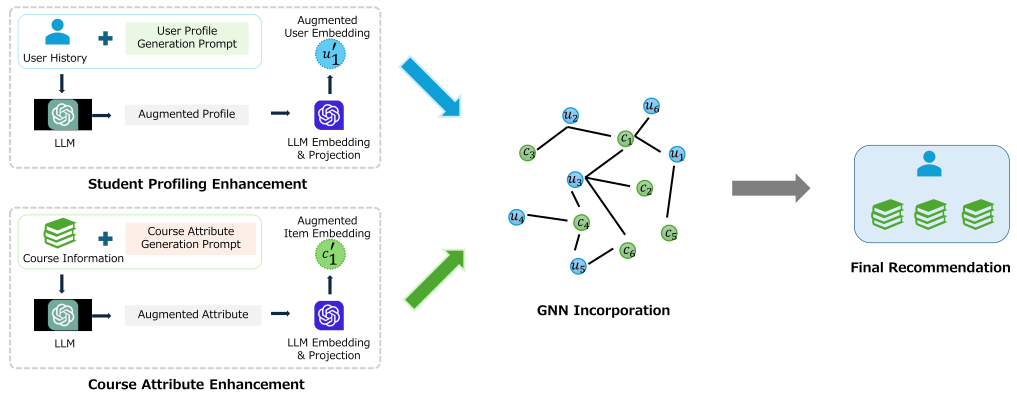
Figure 1 illustrates the overall workflow of SORARec. Given historical student–course interactions and course metadata, SORARec first employs an LLM to infer structured student profiles and learning-relevant course attributes. The inferred profiles and attributes are then encoded into semantic embeddings and aligned with the collaborative embedding space. Next, these semantic representations are propagated over the student–course interaction graph and integrated with interaction-based embeddings to obtain enhanced student and course representations. Finally, SORARec predicts student–course preferences based on the fused representations and generates personalized course recommendations.
3.1 LLM-based Student Profile and Course Attribute Inference
SORARec employs a LLM as an auxiliary inference module to construct structured student profiles and learning-relevant course attributes. In educational platforms, explicit information about students’ learning goals, background knowledge, or difficulty preferences, as well as fine-grained course attributes such as conceptual coverage and pedagogical difficulty, is often unavailable or inconsistently recorded. This information deficiency, combined with sparse interaction data, poses a major challenge for accurate and personalized course recommendations. To address this issue, SORARec leverages the reasoning capability of LLMs to infer missing or implicit attributes from available textual evidence and transforms them into dense semantic representations for downstream recommendation.
Student Profile Inference: For each student \(u\), we collect the historical interaction set \(\mathcal {H}_u=\left \{i_1, i_2, \ldots , i_{\left |\mathcal {H}_u\right |}\right \}\), where each interacted course provides indirect evidence of the student’s latent learning characteristics. Then, SORARec prompts an LLM to infer a structured student profile based on the semantic patterns of the courses previously taken.
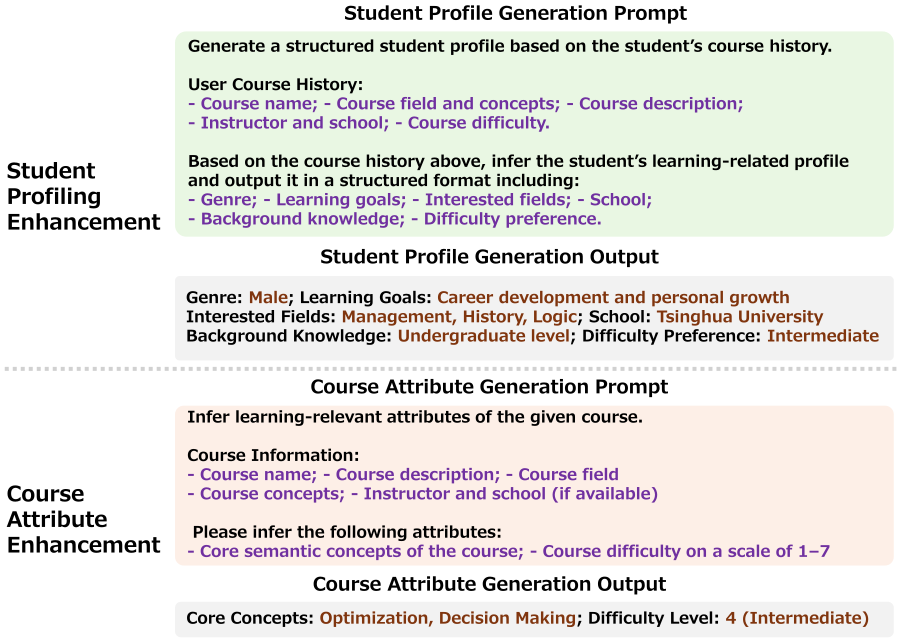
As illustrated in Fig. 2, the prompt consists of a task description, textual information extracted from the student’s enrolled courses (e.g., course titles, topics, and fields), and a strict output schema that enforces a machine-readable format. The LLM is required to infer multiple educationally meaningful facets, such as learning goals, interested fields, background knowledge level, and difficulty preference. Let \(P_u^{\text {prof}}\) denote the constructed prompt for student \(u\), The inferred student profile is obtained as: \[ A_u=\operatorname {LLM}\left (P_u^{\text {prof }}\right ), \] where \(A_u\) is a structured textual description summarizing the student’s latent learning characteristics inferred from historical interactions.
Course Attribute Inference: Similarly, for each course \(i\), SORARec employs an LLM to infer learning-relevant course attributes from available course metadata. Course descriptions in online learning platforms are often written in free-form text and vary widely in granularity and quality, which limits their direct use in recommendation models. To obtain more structured and comparable representations, we prompt the LLM with course-specific information, including the course name, description, field, instructor, institution, and existing annotations when available, which is shown in Fig. 2.
The LLM is instructed to infer pedagogically meaningful attributes, with a particular focus on semantic concepts and course difficulty, which are critical for matching courses with students’ backgrounds and learning objectives. Let \(P_i^{\text {attr }}\) denote the prompt constructed for course \(i\). The inferred course attributes are defined as: \[ A_i=\operatorname {LLM}\left (P_i^{\text {attr }}\right ), \] where \(A_i\) represents the LLM-generated textual description of the course’s semantic and pedagogical characteristics.
Semantic Embedding of Inferred Profiles and Attributes: The inferred student profiles \(A_u\) and course attributes \(A_i\) are textual or structured outputs that cannot be directly consumed by standard recommendation models. As shown in Fig. 1, SORARec converts these inferred attributes into dense semantic representations using an embedding encoder. Formally, the embedding vectors are computed as: \[ \mathbf {f}_{A, u}=\operatorname {Emb}\left (A_u\right ), \quad \mathbf {f}_{A, i}=\operatorname {Emb}\left (A_i\right ), \]
where \(\operatorname {Emb}(\cdot )\) denotes the embedding function and \(\mathbf {f}_{A, u}, \mathbf {f}_{A, i} \in \mathbb {R}^d\) are the resulting student-side and course-side semantic vectors.
By encoding inferred attributes into continuous representations, SORARec enables the integration of high-level educational semantics into the recommendation process while maintaining a lightweight downstream architecture. Notably, the LLM is only used in an offline inference stage, and all subsequent recommendation learning operates on the embedded representations. The utilization of these side information embeddings in the recommendation model is described in the following subsection.
3.2 Side Information Incorporation
After obtaining the LLM-inferred student profiles and course attributes, the key challenge is how to effectively incorporate this information into the course recommendation process. SORARec integrates the inferred student-side and course-side representations with interaction-based learning, enabling the model to jointly exploit collaborative signals from historical enrollments and the semantic characteristics specific to students and courses.
Let \(\mathbf {e}_u \in \mathbb {R}^d\) and \(\mathbf {e}_i \in \mathbb {R}^d\) denote the base embeddings of student \(u\) and course \(i\), respectively, learned from interaction data. From the LLM-based inference module described in Section 3.2, we obtain semantic representations \(\mathbf {f}_{A, u}\) and \(\mathbf {f}_{A, i}\) , which encode the inferred student profiles and course attributes. The inferred semantic representations are first aligned to the recommender embedding space via a projection operation: \[ \overline {\mathbf {f}_u}=\operatorname {Proj}\left (\mathbf {f}_{A, u}\right ), \quad \overline {\mathbf {f}_i}=\operatorname {Proj}\left (\mathbf {f}_{A, i}\right ), \] where \(\overline {\mathbf {f}_u}\) and \(\overline {\mathbf {f}_i}\) denote the projected semantic embedding obtained by mapping the LLM-inferred representation into the recommender embedding space, \(\operatorname {Proj}(\cdot )\) maps the LLM-inferred embeddings from the semantic space to the collaborative embedding space. \(\operatorname {Proj}(\cdot )\) is instantiated as a linear transformation, i.e., \(\operatorname {Proj}(\mathbf {x})=\mathbf {x W}\) with a trainable projection matrix \(\mathbf {W}\), and \(\ell _2\)-normalization is applied to mitigate scale discrepancies between heterogeneous representations. Although dimensionally aligned, the projected semantic features do not explicitly encode collaborative structure. To inject interaction-aware context, SORARec further propagates the projected features over the student–course interaction graph \(\mathcal {G}\): \[ \tilde {\mathbf {f}}_u=\operatorname {GNN}\left (\overline {\mathbf {f}_u}, \mathcal {G}\right ), \quad \tilde {\mathbf {f}_i}=\operatorname {GNN}\left (\overline {\mathbf {f}_i}, \mathcal {G}\right ), \] where \(\tilde {\mathbf {f}}_u\) and \(\tilde {\mathbf {f}}_i\) represent the context-enhanced semantic embedding after injecting collaborative information through message passing on the interaction graph, and \(\operatorname {GNN}\left (\cdot \right )\) denotes a message-passing operation that aggregates neighborhood information from \(\mathcal {G}\). Finally, the context-enhanced semantic features are incorporated into the base embeddings via a residual-style fusion strategy: \[ \mathbf {h}_u=\mathbf {e}_u+\alpha \cdot \frac {\tilde {\mathbf {f}_u}}{\left \|\tilde {\mathbf {f}_u}\right \|_2}, \quad \mathbf {h}_i=\mathbf {e}_i+\alpha \cdot \frac {\tilde {\mathbf {f}_i}}{\left \|\tilde {\mathbf {f}_i}\right \|_2}, \] where \(\alpha \) controls the contribution of semantic side information. The resulting representations \(\mathbf {h}_u\) and \(\mathbf {h}_i\) jointly capture collaborative signals and learning-relevant semantics, and are subsequently used for preference estimation in the recommendation task.
3.3 Recommendation Objective and Optimization
After incorporating LLM-inferred student profiles and course attributes into the collaborative representations, SORARec performs interaction prediction based on the final student and course embeddings. Given the fused representations \(\mathbf {h}_u\) and \(\mathbf {h}_i\) obtained in Section 3.3, the preference score between student \(u\) and course \(i\) is computed via inner product: \[ \hat {y}_{u,i} = \mathbf {h}_u^\top \mathbf {h}_i . \] Following common practice in implicit-feedback recommendation scenarios, we adopt the Bayesian Personalized Ranking (BPR) [23] loss to optimize the model. The BPR objective encourages the predicted score of an observed interaction to be higher than that of an unobserved one. Specifically, for each student \(u\), we construct training triplets \((u, i, j)\), where \(i\) denotes a course that the student has enrolled in, and \(j\) denotes a course with no observed interaction. The loss function is defined as: \[ \mathcal {L}_{\text {BPR}} = - \sum _{(u,i,j) \in \mathcal {D}} \log \sigma \left ( \hat {y}_{u,i} - \hat {y}_{u,j} \right ), \] where \(\sigma (\cdot )\) denotes the sigmoid function and \(\mathcal {D}\) is the set of sampled training triplets. The overall objective function includes an \(\ell _2\) regularization term to prevent overfitting: \[ \mathcal {L} = \mathcal {L}_{\text {BPR}} + \lambda \lVert \Theta \rVert _2^2 , \] where \(\Theta \) represents all trainable parameters in SORARec, including embedding matrices and projection weights, and \(\lambda \) controls the regularization strength. The model is optimized using mini-batch stochastic gradient descent with the Adam [9] optimizer. During inference, SORARec ranks candidate courses for each student based on the predicted scores \(\hat {y}_{u,i}\) and recommends the top-\(K\) courses with the highest scores.
4. EXPERIMENT SETUP
4.1 Datasets
We evaluate SORARec on a publicly available MOOC dataset, MOOCCube [35], which is a large-scale dataset containing 199,199 users, 706 courses, and 672,853 user-course interaction records. Each course is accompanied by textual metadata, including course titles, detailed descriptions, and manually annotated concepts. Following common practice, we preprocess both datasets by removing users with fewer than five interactions and courses with fewer than ten interactions to ensure data quality and stable evaluation. After preprocessing, the statistics of the resulting dataset are summarized in Table 1.
|
Dataset |
Users |
Courses |
Interactions | Interactions |
|---|---|---|---|---|
| Density | ||||
| MOOCCube | 33,838 | 645 | 263,522 | 1.2074% |
4.2 Metrics
Following prior work on course recommendation [37, 34, 3], we evaluate the recommendation performance using four widely adopted top-\(K\) ranking metrics: Precision, Recall, Hit Ratio (HR), and Normalized Discounted Cumulative Gain (NDCG). These metrics assess the quality of the ranked recommendation lists from complementary perspectives, including accuracy, coverage, and ranking quality. For all metrics, higher values indicate better recommendation performance.
| K = 5 | K = 10 | ||||||||
|---|---|---|---|---|---|---|---|---|---|
| Model | Precision@5 | Recall@5 | HR@5 | NDCG@5 | Precision@10 | Recall@10 | HR@10 | NDCG@10 | |
| CF | 0.0525 | 0.1464 | 0.2326 | 0.1118 | 0.0344 | 0.1890 | 0.3005 | 0.1280 | |
| MF | 0.0341 | 0.0973 | 0.1617 | 0.0655 | 0.0328 | 0.1839 | 0.2923 | 0.0989 | |
| LightFM | 0.0492 | 0.1442 | 0.2304 | 0.0950 | 0.0419 | 0.2395 | 0.3651 | 0.1319 | |
| NeuMF | 0.0609 | 0.1719 | 0.2763 | 0.1269 | 0.0469 | 0.2622 | 0.3978 | 0.1608 | |
| LightGCN | 0.0893 | 0.2470 | 0.3782 | 0.2012 | 0.0625 | 0.3433 | 0.5014 | 0.2372 | |
| KEAM | 0.0768 | 0.2018 | 0.2651 | 0.1605 | 0.0495 | 0.2581 | 0.3439 | 0.1819 | |
| SORARec | 0.1021 | 0.2874 | 0.4389 | 0.2740 | 0.0724 | 0.4015 | 0.5711 | 0.3274 | |
4.3 Baselines
To evaluate the effectiveness of SORARec, we compare it with a set of representative baseline methods for course recommendation, covering classical collaborative filtering, factorization-based models, neural recommenders, graph-based approaches, and knowledge-enhanced models. Specifically, we include:
- Item-based CF [24], a memory-based collaborative filtering method that recommends courses based on item similarity computed from historical interactions.
- Matrix Factorization [10], a matrix factorization model that learns latent representations of students and courses from the interaction matrix.
- LightFM [11], a hybrid recommendation model that combines collaborative filtering with side information; we report results under its standard BPR loss.
- NeuMF [6], a neural collaborative filtering model that integrates generalized matrix factorization and multilayer perceptrons to capture nonlinear interactions.
- LightGCN [5], a graph-based collaborative filtering model that propagates embeddings over the student–course interaction graph using simplified graph convolutions.
- KEAM [33], a knowledge-enhanced course recommendation model that incorporates course concepts through an autoencoder-based architecture.
All baseline models are trained and evaluated under the same data splits and evaluation protocol. Hyperparameters are carefully tuned on the validation set, and the best-performing configurations are reported on the test set.
4.4 Training Details
All models were implemented using PyTorch 2.1.2 and trained on a single NVIDIA RTX 4060 Ti GPU. For the MOOCCube dataset, user–course interaction records were randomly split into training, validation, and test sets with a ratio of 8:1:1. For SORARec, LLM-based inference was conducted offline. Student profiles and course attributes were generated using GPT-4o-mini, and the textual outputs were encoded with the text-embedding-3-small model, producing 1536-dimensional semantic embeddings. These embeddings were projected into a 64-dimensional latent space to align with interaction-based representations. All models were evaluated under the same data splits and experimental settings.
5. RESULTS
| K = 5 | K = 10 | K = 15 | K = 20 | ||||||
|---|---|---|---|---|---|---|---|---|---|
| Model | HR@5 | NDCG@5 | HR@10 | NDCG@10 | HR@15 | NDCG@15 | HR@20 | NDCG@20 | |
| Item-based CF | 0.0614 | 0.0570 | 0.1933 | 0.0971 | 0.2495 | 0.1118 | 0.3086 | 0.1259 | |
| Matrix Factorization | 0.1064 | 0.0618 | 0.1996 | 0.0902 | 0.2824 | 0.1129 | 0.3450 | 0.1266 | |
| LightFM | 0.2259 | 0.1442 | 0.3012 | 0.1689 | 0.3494 | 0.1809 | 0.3765 | 0.1862 | |
| NeuMF | 0.2172 | 0.1371 | 0.3140 | 0.1690 | 0.3763 | 0.1848 | 0.4248 | 0.1962 | |
| LightGCN | 0.3062 | 0.2128 | 0.3984 | 0.2406 | 0.4631 | 0.2577 | 0.5184 | 0.2707 | |
| KEAM | 0.3398 | 0.2585 | 0.4095 | 0.2811 | 0.4446 | 0.2904 | 0.4689 | 0.2962 | |
| SORARec | 0.3612 | 0.2736 | 0.4543 | 0.3036 | 0.5064 | 0.3174 | 0.5457 | 0.3267 | |
5.1 Overall Performance Comparison
Table 2 presents the overall performance comparison on the MOOCCube dataset. The main observations are summarized as follows: \((1)\) SORARec consistently achieves the best performance across all evaluation metrics at both \(K=5\) and \(K=10\). This demonstrates the effectiveness of jointly incorporating LLM-inferred student profiles and course attributes into the recommendation process. \((2)\) The improvements indicate that learning-aware semantic representations help SORARec better capture students’ latent learning needs and course suitability, which are difficult to infer from sparse interaction data alone. \((3)\) Compared with strong collaborative and knowledge-enhanced baselines, SORARec still yields clear performance gains, highlighting the importance of simultaneously modeling both student-side and course-side information in educational recommendation. \((4)\) Overall, these results confirm that SORARec provides a robust solution for MOOC recommendation by alleviating data sparsity and improving representation quality.
5.2 Ablation Study
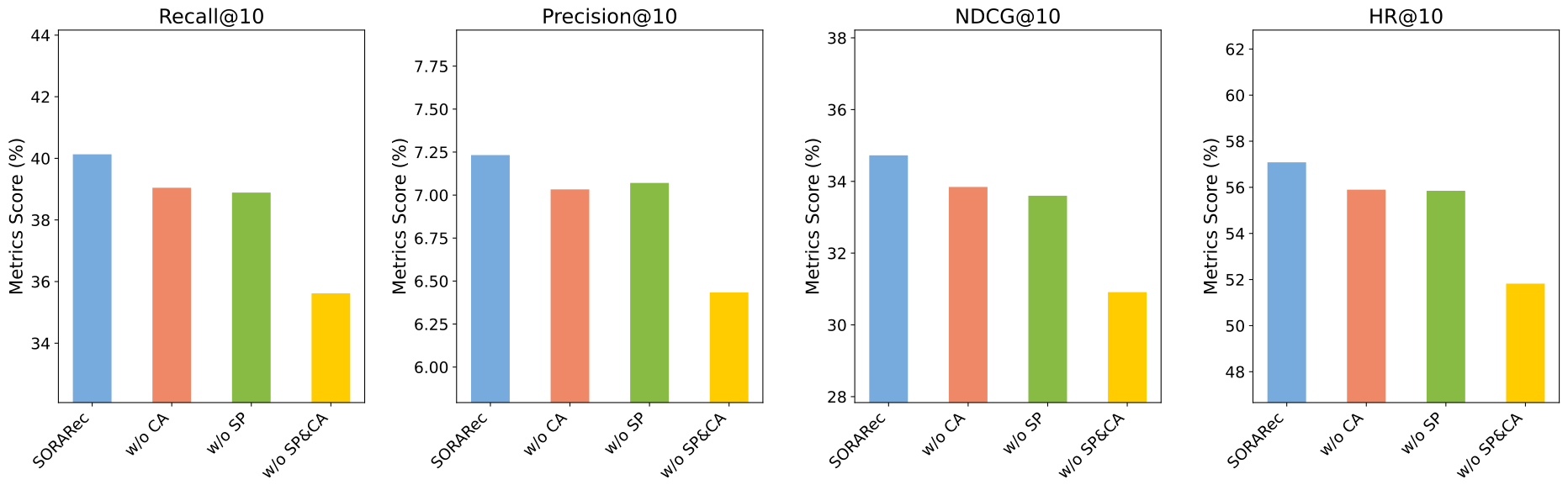
To examine the contribution of LLM-inferred student profiles and course attributes in SORARec, we conduct an ablation study by selectively removing semantic information from different sides of the model. Specifically, we compare the following variants:
- SORARec w/o SP: This variant removes the student profiles and retains only course attributes.
- SORARec w/o CA: This variant removes the course attributes and retains only student profiles.
- SORARec w/o SP&CA: This variant removes both student profiles and course attributes, reducing the model to an interaction-only variant.
These comparisons help demonstrate the importance and impact of each component in the overall SORARec model performance. Based on the results presented in Figure 3, we observe that \((1)\) The SORARec model consistently achieves the best performance across all metrics, demonstrating that jointly modeling student profiles and course attributes is more effective than relying on either side alone. \((2)\) Removing either student profiles or course attributes leads to noticeable performance degradation, indicating that both components contribute meaningful and complementary information. \((3)\) The performance drop is slightly larger when removing student profiles than when removing course attributes, suggesting that student-side semantics play a particularly important role in educational recommendation. This aligns with the nature of learning scenarios, where students’ background knowledge, learning goals, and difficulty preferences strongly influence course suitability. \((4)\) The interaction-only variant (w/o SP & CA) performs the worst, highlighting the limitation of relying solely on sparse enrollment signals. Overall, this ablation study confirms that student profiles and course attributes are both indispensable components of SORARec, and the results further support the importance of explicitly modeling learning-oriented semantics on both sides of the recommendation process.
5.3 Cold-Start Scenario Recommendation
Following the same cold-start setting adopted in prior work [31], we focus on the user cold-start scenario on the MOOCCube dataset by selecting users with no more than five historical interactions. The experimental results are reported in Table 3. The main findings are summarized as follows: (1) SORARec consistently achieves the best performance under cold-start conditions across all Top-\(K\) settings. In particular, SORARec outperforms all baselines in both HR and NDCG, demonstrating its strong robustness when user interaction histories are extremely limited. (2) The performance advantage of SORARec becomes more evident as \(K\) increases. At \(K=10\), \(15\), and \(20\), SORARec shows clear and stable improvements over strong baselines such as LightGCN and KEAM, indicating its superior ability to rank relevant courses higher for cold-start users. (3) Compared with interaction-driven models, SORARec benefits from LLM-inferred student profiles and course attributes, which provide learning-aware semantic signals beyond sparse behavioral data. These semantic representations effectively compensate for missing interactions and enable more reliable preference estimation in cold-start scenarios. (4) Overall, the results confirm that SORARec is particularly well-suited for user cold-start recommendation. By jointly leveraging collaborative information and inferred educational semantics, SORARec substantially improves recommendation performance under sparse data conditions. While all models benefit from sufficient interaction histories in the general setting (Section 5.1), cold-start evaluation provides a clearer view of how effectively learning-aware semantic representations can compensate for missing behavioral signals.
6. CONCLUSIONS
In this paper, we proposed SORARec and explored the use of large language models to enhance course recommendation by enriching both the student side and the course side with inferred semantic information. Specifically, we leveraged LLMs to generate structured student profiles from historical learning behaviors and to extract learning-relevant attributes from course descriptions, and incorporated these signals into the recommendation process. Experimental results show that augmenting student and course representations with LLM-inferred information leads to consistent performance improvements over baseline methods, particularly in sparse interaction settings. Rather than treating LLMs as end-to-end recommenders, our findings suggest that their strength in this context lies in supporting the understanding and modeling of students and courses, thereby complementing data-driven recommendation models.
However, this work has several limitations pointing to directions for future research. First, the current framework focuses on augmenting student profiles and course attributes, but does not explicitly address interaction-level completion. A natural extension is to allow LLMs to predict potential liked and disliked courses by jointly considering student profiles and course attributes, thereby enriching the interaction space under sparse or cold-start conditions. Second, LLM-generated content is inherently subject to hallucination and uncertainty, which may introduce noise into the recommendation process. Future work will explore mechanisms to mitigate these effects, such as constrained generation, consistency checking across multiple prompts, and verification against existing course information. Finally, our evaluation relies on offline recommendation metrics, which cannot fully reflect the educational validity of the generated profiles and recommendations. We therefore plan to conduct user studies involving students and instructors, asking them to assess the accuracy, plausibility, and usefulness of the inferred student profiles, course attributes, and predicted preferences. Such human-centered evaluation will be crucial for understanding the practical value and limitations of LLM-augmented course recommendation in real educational settings.
7. ACKNOWLEDGMENTS
This work was supported by JST SPRING, Grant Number JPMJSP2136, JSPS KAKENHI Grant Numbers JP20H00622, JP24K20903 and JP25K03230.
8. REFERENCES
- A. Barany, N. Nasiar, C. Porter, A. F. Zambrano, A. L. Andres, D. Bright, M. Shah, X. Liu, S. Gao, J. Zhang, et al. Chatgpt for education research: exploring the potential of large language models for qualitative codebook development. In International conference on artificial intelligence in education, pages 134–149. Springer, 2024.
- T. Brown, B. Mann, N. Ryder, M. Subbiah, J. D. Kaplan, P. Dhariwal, A. Neelakantan, P. Shyam, G. Sastry, A. Askell, et al. Language models are few-shot learners. Advances in neural information processing systems, 33:1877–1901, 2020.
- J. Frej, N. Shah, M. Knezevic, T. Nazaretsky, and T. Käser. Finding paths for explainable mooc recommendation: A learner perspective. In Proceedings of the 14th Learning Analytics and Knowledge Conference, pages 426–437, 2024.
- W. Gao, Q. Liu, Z. Huang, Y. Yin, H. Bi, M.-C. Wang, J. Ma, S. Wang, and Y. Su. Rcd: Relation map driven cognitive diagnosis for intelligent education systems. In Proceedings of the 44th international ACM SIGIR conference on research and development in information retrieval, pages 501–510, 2021.
- X. He, K. Deng, X. Wang, Y. Li, Y. Zhang, and M. Wang. Lightgcn: Simplifying and powering graph convolution network for recommendation. In Proceedings of the 43rd International ACM SIGIR conference on research and development in Information Retrieval, pages 639–648, 2020.
- X. He, L. Liao, H. Zhang, L. Nie, X. Hu, and T.-S. Chua. Neural collaborative filtering. In Proceedings of the 26th international conference on world wide web, pages 173–182, 2017.
- F. Huang, Y. Bei, Z. Yang, J. Jiang, H. Chen, Q. Shen, S. Wang, F. Karray, and P. S. Yu. Large language model simulator for cold-start recommendation. In Proceedings of the Eighteenth ACM International Conference on Web Search and Data Mining, pages 261–270, 2025.
- X. Jing and J. Tang. Guess you like: course recommendation in moocs. In Proceedings of the international conference on web intelligence, pages 783–789, 2017.
- D. P. Kingma and J. Ba. Adam: A method for stochastic optimization. arXiv preprint arXiv:1412.6980, 2014.
- Y. Koren, R. Bell, and C. Volinsky. Matrix factorization techniques for recommender systems. Computer, 42(8):30–37, 2009.
- M. Kula. Metadata embeddings for user and item cold-start recommendations. In T. Bogers and M. Koolen, editors, Proceedings of the 2nd Workshop on New Trends on Content-Based Recommender Systems co-located with 9th ACM Conference on Recommender Systems (RecSys 2015), Vienna, Austria, September 16-20, 2015., volume 1448 of CEUR Workshop Proceedings, pages 14–21. CEUR-WS.org, 2015.
- J. Lin, E. Chen, Z. Han, A. Gurung, D. R. Thomas, W. Tan, N. D. Nguyen, and K. R. Koedinger. How can i improve? using gpt to highlight the desired and undesired parts of open-ended responses. In Proceedings of the 17th International Conference on Educational Data Mining, pages 236–250, Atlanta, Georgia, USA, July 2024. International Educational Data Mining Society.
- B. Ma, M. A. Z. Khan, T. Yang, A. Polyzou, and S. Konomi. Evaluating the effectiveness of large language models for course recommendation tasks. In International Conference on Computers in Education, 2025.
- B. Ma, M. Lu, Y. Taniguchi, and S. Konomi. Courseq: the impact of visual and interactive course recommendation in university environments. Research and practice in technology enhanced learning, 16:1–24, 2021.
- B. Ma, Y. Taniguchi, and S. Konomi. Course recommendation for university environments. International educational data mining society, 2020.
- B. Ma, T. Yang, and B. Ren. A survey on explainable course recommendation systems. In N. A. Streitz and S. Konomi, editors, Distributed, Ambient and Pervasive Interactions, pages 273–287, Cham, 2024. Springer Nature Switzerland.
- H. Ma, J. Zhu, S. Yang, Q. Liu, H. Zhang, X. Zhang, Y. Cao, and X. Zhao. A prerequisite attention model for knowledge proficiency diagnosis of students. In Proceedings of the 31st ACM International Conference on Information & Knowledge Management, pages 4304–4308, 2022.
- R. Morsomme and S. V. Alferez. Content-based course recommender system for liberal arts education. International educational data mining society, 2019.
- S. Morsy, G. Karypis, et al. Will this course increase or decrease your gpa? towards grade-aware course recommendation. Journal of Educational Data Mining, 11(2):20–46, 2019.
- J. Naren, M. Z. Banu, and S. Lohavani. Recommendation system for students’ course selection. In Smart Systems and IoT: Innovations in Computing: Proceeding of SSIC 2019, pages 825–834. Springer, 2020.
- A. Polyzou, A. N. Nikolakopoulos, and G. Karypis. Scholars walk: A markov chain framework for course recommendation. International Educational Data Mining Society, 2019.
- J. Rao, C. Borchers, and J. Lin. Coursera-rec: Explainable moocs course recommendation using rag-facilitated llms. 2024. Accessed: 2025-06-22.
- S. Rendle, C. Freudenthaler, Z. Gantner, and L. Schmidt-Thieme. Bpr: Bayesian personalized ranking from implicit feedback. arXiv preprint arXiv:1205.2618, pages 452–461, 2012.
- B. Sarwar, G. Karypis, J. Konstan, and J. Riedl. Item-based collaborative filtering recommendation algorithms. In Proceedings of the 10th international conference on World Wide Web, pages 285–295, 2001.
- J. Wang, H. Lu, J. Caverlee, E. H. Chi, and M. Chen. Large language models as data augmenters for cold-start item recommendation. In Companion Proceedings of the ACM Web Conference 2024, pages 726–729, 2024.
- J. Wei, Y. Tay, R. Bommasani, C. Raffel, B. Zoph, S. Borgeaud, D. Yogatama, M. Bosma, D. Zhou, D. Metzler, E. H. Chi, T. Hashimoto, O. Vinyals, P. Liang, J. Dean, and W. Fedus. Emergent abilities of large language models. Transactions on Machine Learning Research, 2022.
- W. Wei, X. Ren, J. Tang, Q. Wang, L. Su, S. Cheng, J. Wang, D. Yin, and C. Huang. Llmrec: Large language models with graph augmentation for recommendation. In Proceedings of the 17th ACM International Conference on Web Search and Data Mining, pages 806–815, 2024.
- L. Wu, Z. Zheng, Z. Qiu, H. Wang, H. Gu, T. Shen, C. Qin, C. Zhu, H. Zhu, Q. Liu, et al. A survey on large language models for recommendation. World Wide Web, 27(5):60, 2024.
- T. Yang, B. Ren, C. Gu, B. Ma, T. He, and S. Konomi. Towards better course recommendations: integrating multi-perspective meta-paths and knowledge graphs. In Proceedings of the 15th international learning analytics and knowledge conference, pages 137–147, 2025.
- T. Yang, B. Ren, C. Gu, B. Ma, and S. Konomi. Leveraging gpt for concept generation and knowledge graph construction in educational recommender systems. In Teaching and Learning in the Generative Artificial Intelligence Age, pages 75–96. Springer, 2026.
- T. Yang, B. Ren, C. Gu, F. Xu, B. Ma, and S. Konomi. Enhancing course recommendation with llm-generated concepts: A unified framework for side information integration. Big Data and Cognitive Computing, 9(12):311, 2025.
- T. Yang, B. Ren, B. Ma, T. He, C. Gu, and S. Konomi. Boosting course recommendation explainability: A knowledge entity aware model using deep learning. In Proceedings of the 32nd International Conference on Computers in Education, ICCE2024, pages 360–366. Asia-Pacific Society for Computers in Education, 2024.
- T. Yang, B. Ren, B. Ma, M. A. Z. Khan, T. He, and S. Konomi. Making course recommendation explainable: A knowledge entity-aware model using deep learning. In Proceedings of the 17th International Conference on Educational Data Mining, pages 658–663, Atlanta, Georgia, USA, July 2024. International Educational Data Mining Society.
- Y. Yang, C. Zhang, X. Song, Z. Dong, H. Zhu, and W. Li. Contextualized knowledge graph embedding for explainable talent training course recommendation. ACM Trans. Inf. Syst., 42(2), sep 2023.
- J. Yu, G. Luo, T. Xiao, Q. Zhong, Y. Wang, W. Feng, J. Luo, C. Wang, L. Hou, J. Li, Z. Liu, and J. Tang. MOOCCube: A large-scale data repository for NLP applications in MOOCs. In D. Jurafsky, J. Chai, N. Schluter, and J. Tetreault, editors, Proceedings of the 58th Annual Meeting of the Association for Computational Linguistics, pages 3135–3142, Online, July 2020. Association for Computational Linguistics.
- X. Yu, Q. Mao, X. Wang, Q. Yin, X. Che, and X. Zheng. Cr-lcrp: Course recommendation based on learner–course relation prediction with data augmentation in a heterogeneous view. Expert Systems with Applications, 249:123777, 2024.
- J. Zhang, B. Hao, B. Chen, C. Li, H. Chen, and J. Sun. Hierarchical reinforcement learning for course recommendation in moocs. In Proc. AAAI conf artificial intelligence, volume 33(1), pages 435–442, 2019.
© 2026 Copyright is held by the author(s). This work is distributed under the Creative Commons Attribution-NonCommercial-NoDerivatives 4.0 International (CC BY-NC-ND 4.0) license.