The Integration Trap and Toward Enactment-Aware Scaffolding
ABSTRACT
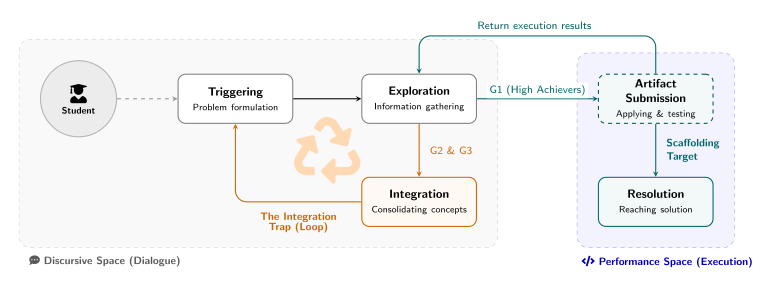
How does student–GenAI interaction quality vary with academic achievement? We introduce coordination regimes, a descriptive lens informed by the control-theoretic model of self-regulated learning, to characterize how students align cognitive goals, prompting actions, and inquiry phases in dialogue with GenAI. We coded 2,243 dialogue turns from 136 undergraduates along three dimensions (Learning Intention, Prompt Communicative Function, and Cognitive Presence) and analyzed them using Epistemic Network Analysis (ENA), Sequential Pattern Mining (SPM), and ANCOVA controlling for prior GPA. High achievers showed tighter co-occurrence structures linking reasoning, prompting, and resolution-oriented inquiry, while lower-achieving students more often exhibited what we term the integration trap: integration without enactment, in which students consolidate understanding without progressing to resolution. Sequential analyses further revealed “delegate-then-verify” patterns among high achievers versus “delegate-then-retreat” patterns among low achievers. Artifact Submission (students returning with execution results for AI diagnosis) showed the largest group difference (\(\chi ^2 = 31.83\), \(p < .001\)) and emerged as a promising scaffolding target. After controlling for prior GPA, learning intention differences were attenuated, whereas cognitive presence differences remained significant (\(p = .011\)), suggesting that the enactment layer of student–GenAI interaction may be partially distinct from prior academic ability and potentially scaffoldable.
Keywords
1. INTRODUCTION
Generative AI (GenAI) tools offer new possibilities for personalized learning support [8, 10]. As these tools become embedded in coursework, a central question is not simply whether students use GenAI, but how interaction quality differs across learners. Prior work has examined student–AI interaction through isolated lenses: prompt types and usage frequencies [11, 4, 14], co-occurrence structures [9], or learner profiles [7]. These approaches yield useful insights but typically treat cognitive goals, communicative actions, and inquiry processes as separate targets.
This separation limits what we can learn about interaction quality. Effective student–GenAI interaction is not reducible to asking higher-level questions, using particular prompt forms, or reaching later inquiry phases in isolation. Rather, it depends on how these elements work together as a coordinated system during dialogue. To capture this, we introduce coordination regimes, a descriptive analytic lens informed by the control-theoretic model of self-regulated learning [3, 15, 17]. In this model, goal-directed learning involves a reference value (the goal), an output function (the action taken), and an input function (monitoring progress) [3]. We operationalize these functions as Learning Intention, Prompt Communicative Function (PCF), and Cognitive Presence, respectively (Figure 1). We call the resulting group-level pattern of code co-occurrences and sequential transitions across these three dimensions a coordination regime. The analytic value lies not in proposing new categories for Bloom’s taxonomy or the Cognitive Presence framework, but in examining how goal, action, and monitoring indicators align or misalign within student–GenAI interaction.
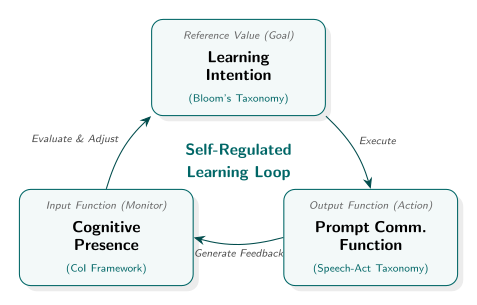
We make three contributions. First, we offer coordination regimes as a conceptual lens for analyzing student–GenAI interaction as a coupled regulatory system rather than a set of independent variables. Second, we identify the integration trap, a recurring pattern in which lower-achieving students consolidate understanding without enacting or testing solutions. Third, we show that Artifact Submission (students returning with execution results for AI diagnosis) is a promising candidate target for enactment-aware scaffolding, supported by evidence that cognitive presence differences are not fully explained by prior academic ability.
We address three research questions:
RQ1. How do coordination regimes differ across achievement groups in the co-occurrence structure of Learning Intention, Prompt Communicative Function, and Cognitive Presence?
RQ2. How do turn-level sequential interaction patterns differ across groups?
RQ3. Do observed interaction differences persist after controlling for prior academic ability?
2. METHOD
The dataset comprised 136 third-year undergraduate students majoring in Statistics who were enrolled in a data mining course and used a GenAI assistant (Doubao, powered by ByteDance; a general-purpose conversational AI with code generation capabilities, comparable to ChatGPT in functionality) during Weeks 6–9 of a 16-week semester. The sample included 81 female students (59.6%) and 55 male students (40.4%). Students were stratified into three achievement tiers by final grade tertiles: G1 (High, \(n=52\)), G2 (Mid, \(n=46\)), G3 (Low, \(n=38\)); smaller group sizes in lower tiers reflect more students excluded for absent or invalid dialogue records. The study was approved by the university ethics committee, and students provided informed consent for the use of their anonymized learning data. Dialogue records and grade information were de-identified before analysis, and all results are reported in aggregate. In total, 481 student-week observations containing 2,243 dialogue turns were collected. Each student contributed an average of 3.49 weekly observations (\(SD = 1.04\)).
Each turn was coded along three dimensions (Table 1). Learning Intention captures the prompt-expressed cognitive goal level (Remember through Create) via Bloom’s revised taxonomy [2]. We use this term operationally to refer to enacted cognitive goals, not latent psychological intentions. Prompt Communicative Function (PCF) classifies prompts by their primary communicative function, i.e., what the student is trying to do, using six categories derived from speech act theory [12] and refined through pilot coding. Cognitive Presence captures the phase of inquiry via the Community of Inquiry framework [5]: Triggering, Exploration, Integration, and Resolution.
| Dimension | Code | Definition | Source |
|---|---|---|---|
| Learning Intention | Remember | Recall or recognize factual information | Bloom’s Revised Taxonomy [2] |
| Understand | Explain or summarize concepts | ||
| Apply | Use knowledge in a concrete task | ||
| Analyze | Break down or compare components | ||
| Evaluate | Judge, test, or diagnose outputs | ||
| Create | Design or produce original artifacts | ||
| Prompt Comm. Function (PCF) | Knowledge Query (KQ) | Ask for factual or conceptual information | Speech Act Theory [12] |
| Task Delegation (TD) | Request AI to perform a task (e.g., write code) | ||
| Contextualized Query (CQ) | Query grounded in student’s own context | ||
| Artifact Submission (AS) | Submit execution output for AI diagnosis | ||
| Elaboration (EF) | Follow up or refine a prior exchange | ||
| Output Shaping (OS) | Request format or style changes to output | ||
| Cognitive Presence | Triggering | Recognize a problem or sense of puzzlement | Community of Inquiry [5] |
| Exploration | Search for information or alternatives | ||
| Integration | Connect ideas into a coherent understanding | ||
| Resolution | Apply or test the solution in practice |
Inter-rater reliability was established on a random 20% sample (\(n = 449\) turns) coded independently by two experts. Cohen’s \(\kappa \): Learning Intention = 0.72, PCF = 0.83, Cognitive Presence = 0.68. Disagreements were resolved through discussion, and the remaining turns were coded by the first author.
We used three complementary analyses. ENA [13] modeled co-occurrence structures (units: students; conversations: student-weeks; stanza window: entire conversation within each student-week; codes: 16 binary codes across three dimensions), capturing which codes connect within sessions. SPM [1] complemented ENA by capturing how codes unfold turn by turn; bigram and trigram frequencies were extracted from turn-level code sequences, expressed as proportions of all bigrams within each group, and compared across groups using chi-square tests with Benjamini–Hochberg correction (all \(p\)-values reported for SPM are BH-corrected). Groups were compared on ENA network positions using pairwise \(t\)-tests with Bonferroni correction. To test whether observed differences persisted beyond baseline ability, we ran ANCOVA controlling for prior-semester GPA. Together, these analyses aligned with the three research questions: ENA addressed RQ1 by comparing group-level co-occurrence structures, SPM addressed RQ2 by comparing turn-level bigram and trigram patterns, and ANCOVA addressed RQ3 by testing whether group differences persisted after controlling for prior-semester GPA.
3. RESULTS
3.1 Co-occurrence Structure (RQ1)
At the learning-intention dimension, differences were present but modest at the structural level, with stronger contrasts emerging in sequential analyses reported later. ENA networks showed that high achievers (G1) formed stronger connections along the Understand–Apply–Evaluate chain, while G2 and G3 showed more evenly distributed connections among lower-level goals (Remember–Understand–Apply) without reaching Evaluate (Figure 3). Group differences on ENA’s primary dimension (SVD1) were not statistically significant after Bonferroni correction (G1 vs. G2: \(d = 0.40\), \(p = .050\); G1 vs. G3: \(d = 0.40\), \(p = .061\); G2 vs. G3: n.s.), consistent with the ANCOVA attenuation reported in RQ3.
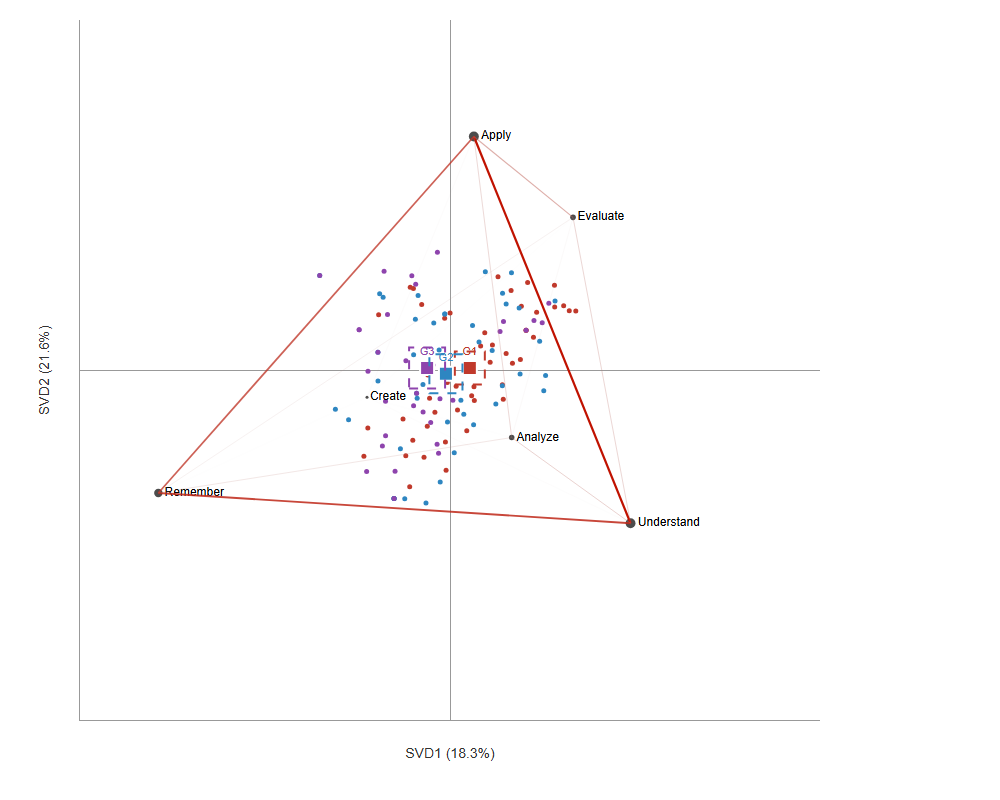
(a) G1 (High Achievers)
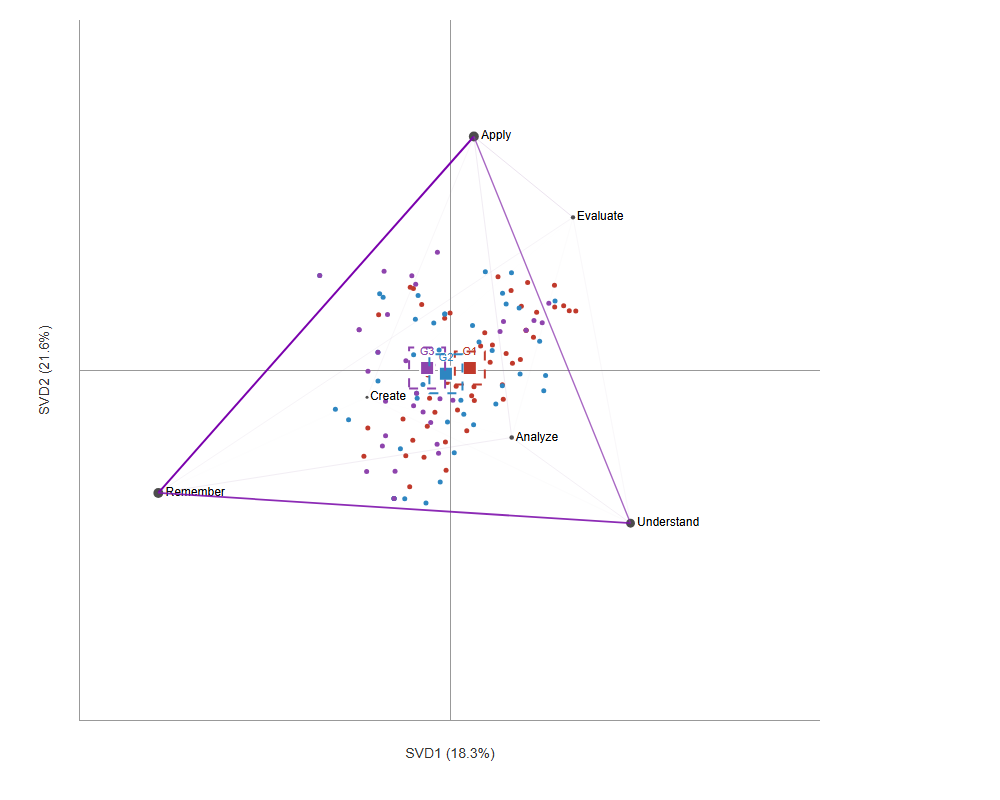
(b) G3 (Lower Achievers)
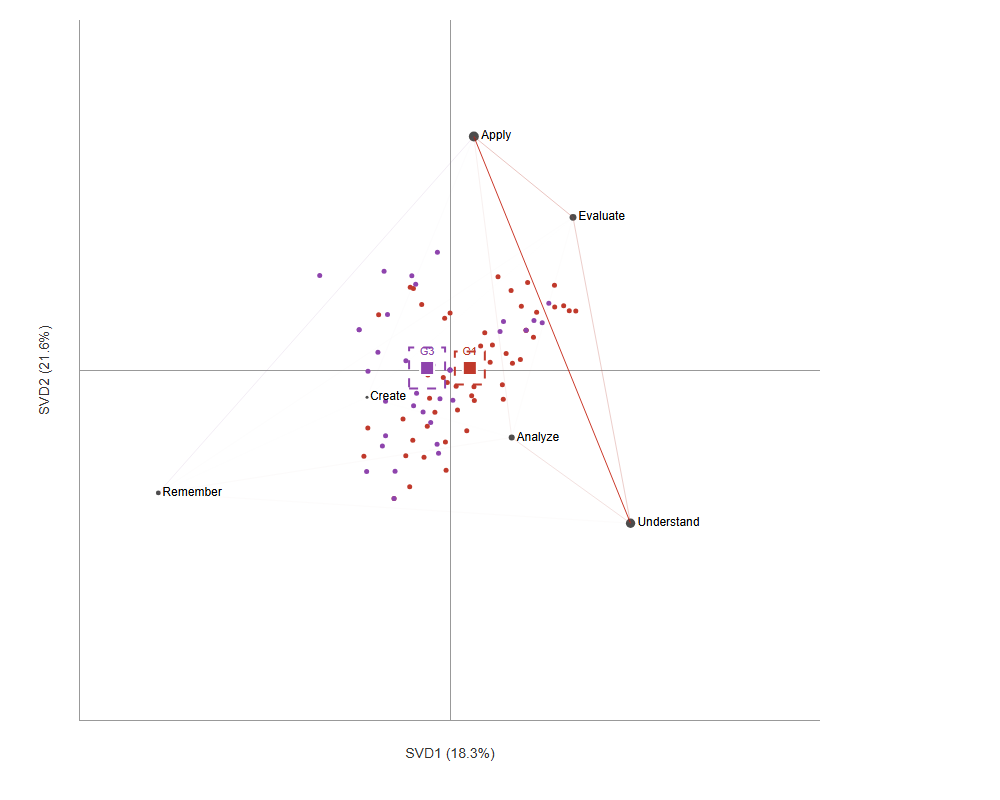
(c) Contrast (G1 \(-\) G3)
At the prompt-function dimension, five of the six PCF codes differed significantly across achievement groups (Table 2), but Artifact Submission (AS) stood out as the clearest behavioral marker. In AS turns, students submit their own execution results, such as error messages or code output, for AI diagnosis. AS showed the largest group difference of any code across all three dimensions (G1: 14.5%, G3: 5.1%, \(\chi ^2(2) = 31.83\), \(p < .001\)). This finding is reinforced by cross-dimensional patterns: 51.0% of AS turns co-occurred with Evaluate-level intentions and 6.9% reached the Resolution phase. By contrast, Knowledge Query, the most common PCF code overall, was dominated by Remember and Understand (77.9%), with Resolution near-absent (0.2%).
| PCF Code | G1 | G2 | G3 | \(\chi ^2(2)\) | \(V\) |
|---|---|---|---|---|---|
| Knowledge Query | 54.5% | 65.9% | 63.9% | 26.78*** | .109 |
| Task Delegation | 17.1% | 17.7% | 23.0% | 7.88* | .059 |
| Artifact Submission | 14.5% | 9.2% | 5.1% | 31.83*** | .119 |
| Contextualized Query | 6.7% | 3.0% | 1.1% | 28.40*** | .113 |
| Elaboration | 6.0% | 4.2% | 5.5% | 2.71 | .035 |
| Output Shaping | 1.4% | 0.0% | 1.3% | 9.14* | .064 |
At the cognitive-presence dimension, the clearest structural separation across achievement groups appeared in inquiry-phase patterns, where lower-achieving students were displaced toward Integration rather than Resolution. ENA networks showed that high achievers (G1) leaned toward Resolution, whereas G2 and G3 clustered near Integration (Figure 4). These structural differences along the primary network dimension (SVD1) were statistically significant after Bonferroni correction (G1 vs. G2: \(d = 0.64\), \(p = .002\); G1 vs. G3: \(d = 0.55\), \(p = .011\); G2 vs. G3: n.s.). This provides evidence for what we term the integration trap: lower-achieving students sustained inquiry cycles but consolidated understanding rather than testing solutions in practice, a pattern of integration without enactment.
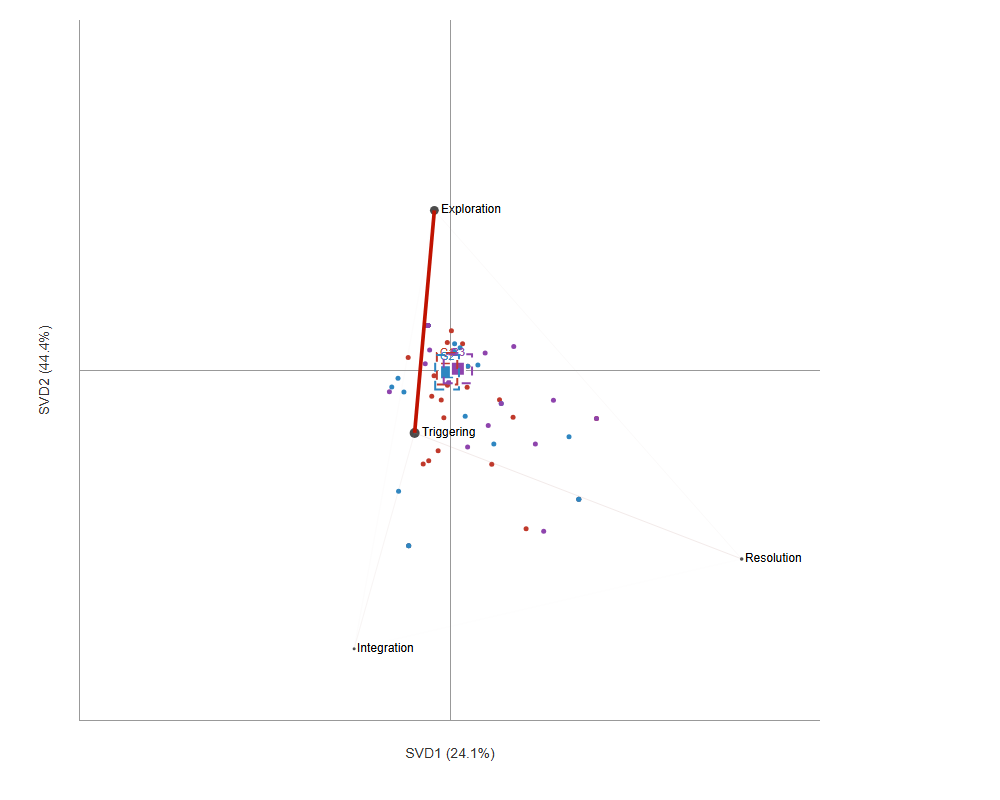
(a) G1 (High Achievers)
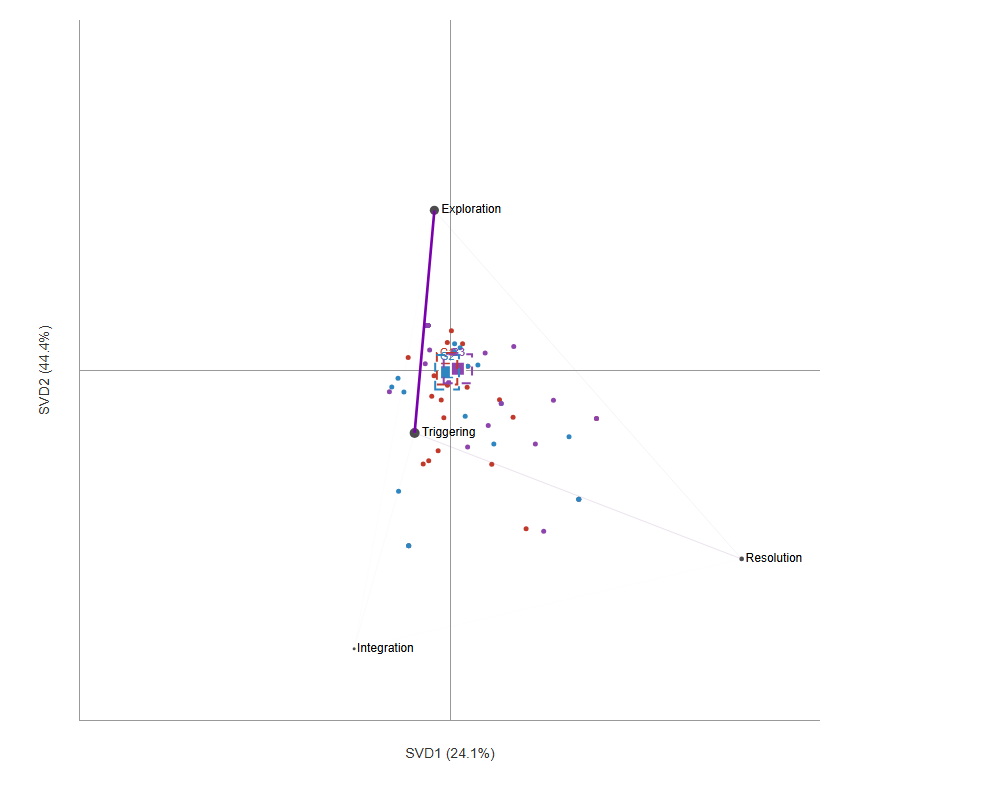
(b) G3 (Lower Achievers)
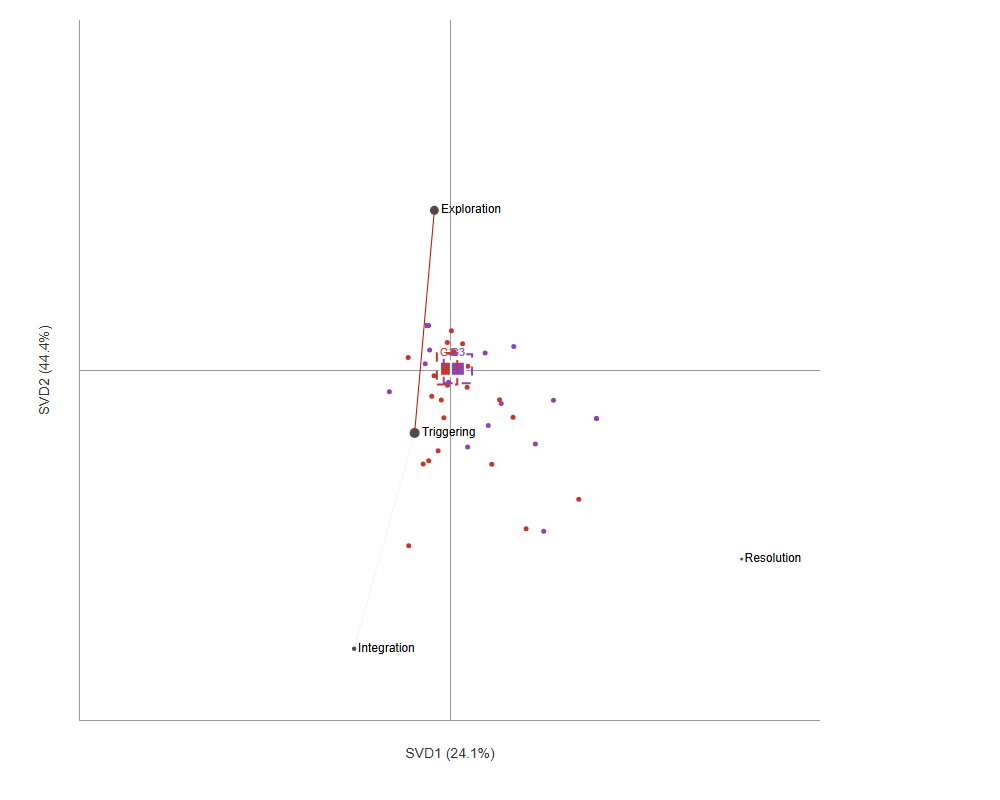
(c) Contrast (G1 \(-\) G3)
Despite these group differences, 75.1% of all coded turns remained in the Triggering phase across all groups, with Integration (3.2%) and Resolution (4.4%) rarely observed, consistent with prior findings that cognitive presence frequently stalls at lower phases [6].
3.2 Sequential Patterns (RQ2)
Sequential analyses revealed sharper contrasts, clarifying how coordination regimes unfold turn by turn.
For Learning Intention sequences, Understand\(\rightarrow \)Apply appeared at 24.7% in G1 versus 8.6% in G3, and Apply\(\rightarrow \)Evaluate at 20.1% versus 7.5%, indicating that high achievers progressed upward through Bloom’s levels within their dialogues while lower achievers remained at foundational levels.
For prompt sequences, the contrasts were even sharper. TD\(\rightarrow \)AS (“delegate-then-verify”) occurred in G1 at four times the rate of G3 (3.7% vs. 0.9%, \(p = .009\)). Sustained debugging chains (AS\(\rightarrow \)AS\(\rightarrow \)AS) were present in G1 (3.5%) but entirely absent in G3. Conversely, TD\(\rightarrow \)KQ (“delegate-then-retreat”) was most frequent in G3 (12.1% vs. 5.6% in G1, \(p < .001\)). These patterns indicate that high achievers close the loop by verifying AI-generated solutions, while lower achievers return to conceptual questioning.
3.3 Does Prior Ability Explain the Differences? (RQ3)
To test whether these differences merely reflect pre-existing ability, we ran ANCOVAs controlling for prior-semester GPA.
The two dimensions behaved differently once baseline ability was accounted for. Learning Intention differences were no longer significant (\(F(2, 132) = 2.30\), \(p = .104\), \(\eta ^2_p = .034\)): what students asked about largely reflected their pre-existing competence. By contrast, Cognitive Presence differences remained significant (\(F(2, 132) = 4.70\), \(p = .011\), \(\eta ^2_p = .066\)): how students navigated the inquiry process differed across groups even after controlling for ability. That is, the group effect was fully attenuated for Learning Intention but retained for Cognitive Presence, suggesting that the enactment dimension of the coordination regime is not simply a by-product of prior ability and may be open to scaffolding.
4. DISCUSSION AND IMPLICATIONS
This study argues that differences in student–GenAI interaction are best understood as differences in coordination regimes (Figure 2). Lower-achieving students more often exhibited the integration trap: consolidating understanding without enacting or testing solutions. Higher-achieving students more often closed the loop through Artifact Submission, returning with execution results that enabled diagnosis and movement toward resolution.
The ANCOVA results suggest a dimension-specific interpretation. Learning Intention differences were attenuated after controlling for prior-semester GPA, whereas Cognitive Presence differences remained, consistent with the possibility that goal selection is more tightly coupled to prior competence while enactment is not fully explained by prior ability and may be open to scaffolding. At the same time, our observational design does not support strong causal claims, and future experimental work is needed to test whether scaffolding enactment changes learning behavior or outcomes.
These findings have practical implications for learning analytics and GenAI-supported instruction. In particular, Artifact Submission appears promising as an observable trace-level marker and candidate design target because it is visible in dialogue logs, detectable automatically, and potentially responsive to real-time nudges. Rather than focusing only on prompt engineering [14, 16], educators and systems might test scaffolds that encourage enactment: running code, testing outputs, bringing back errors, and iterating on concrete artifacts. More broadly, assessment may need to place greater value on artifacts of enactment (such as tested code or verified outputs) than on artifacts of inquiry alone, such as chat transcripts.
4.1 Limitations and Future Work
While this study identifies coordination regimes in student–GenAI interaction, several boundary conditions should be considered. The study was conducted in a coding-heavy data mining course, where Artifact Submission often involved executable code, error messages, or output traces; future work should examine whether analogous enactment markers appear in less technical learning contexts. The measures also relied on dialogue logs. Learning Intention therefore captures prompt-expressed cognitive goals rather than latent psychological intentions, and the PCF coding scheme, although pilot-refined and reliable in this dataset, requires further validation across learning domains. Because achievement groups were defined within a single course, future studies should examine whether similar coordination patterns appear across courses, institutions, and learning tasks. Experimental work is also needed to test whether enactment-aware scaffolds change interaction patterns and learning outcomes.
5. ACKNOWLEDGMENTS
This work was supported by the Research Grants Council of Hong Kong Research Fellow Scheme (Reference no: RFS2223-7H02). Generative AI (e.g., ChatGPT-5.1) was used to improve the readability and clarity of the manuscript. After using this tool, the authors carefully reviewed the content. They fully accept responsibility for the publication’s content.
6. REFERENCES
- R. Agrawal and R. Srikant. Mining sequential patterns. In Proceedings of the Eleventh International Conference on Data Engineering, pages 3–14. IEEE Computer Society, 1995.
- L. W. Anderson and D. R. Krathwohl. A Taxonomy for Learning, Teaching, and Assessing: A Revision of Bloom’s Taxonomy of Educational Objectives. Longman, New York, 2001.
- C. S. Carver and M. F. Scheier. On the Self-Regulation of Behavior. Cambridge University Press, 1998.
- H. Crompton and D. Burke. The educational affordances and challenges of chatgpt: State of the field. TechTrends, 68(2):380–392, 2024.
- D. R. Garrison, T. Anderson, and W. Archer. Critical inquiry in a text-based environment: Computer conferencing in higher education. The Internet and Higher Education, 2(2–3):87–105, 1999.
- D. R. Garrison and M. Cleveland-Innes. Facilitating cognitive presence in online learning: Interaction is not enough. American Journal of Distance Education, 19(3):133–148, 2005.
- H. Güner and E. Er. Ai in the classroom: Exploring students’ interaction with chatgpt in programming learning. Education and Information Technologies, 30(9):12681–12707, 2025.
- E. Kasneci et al. Chatgpt for good? on opportunities and challenges of large language models for education. Learning and Individual Differences, 103:102274, 2023.
- W. Li, H.-Y. Chang, A. Bradford, L. Gerard, and M. C. Linn. Combining natural language processing with epistemic network analysis to investigate student knowledge integration within an ai dialog. Journal of Science Education and Technology, 34(5):980–993, 2025.
- C. K. Lo. What is the impact of chatgpt on education? a rapid review of the literature. Education Sciences, 13(4):410, 2023.
- G. Sawalha, I. Taj, and A. Shoufan. Analyzing student prompts and their effect on ChatGPT’s performance. Cogent Education, 11(1):2397200, 2024.
- J. R. Searle. Speech Acts: An Essay in the Philosophy of Language. Cambridge University Press, 1969.
- D. W. Shaffer, W. Collier, and A. R. Ruis. A tutorial on epistemic network analysis: Analyzing the structure of connections in cognitive, social, and interaction data. Journal of Learning Analytics, 3(3):9–45, 2016.
- J. White et al. A prompt pattern catalog to enhance prompt engineering with chatgpt. In Proceedings of the 30th Conference on Pattern Languages of Programs, PLoP ’23, pages 1–31, Allerton Park, Monticello, IL, USA, 2023. ACM.
- P. H. Winne. A metacognitive view of individual differences in self-regulated learning. Learning and Individual Differences, 8(4):327–353, 1996.
- J. D. Zamfirescu-Pereira, R. Y. Wong, B. Hartmann, and Q. Yang. Why Johnny can’t prompt: How non-AI experts try (and fail) to design LLM prompts. In Proceedings of the 2023 CHI Conference on Human Factors in Computing Systems, pages 1–21. ACM, 2023.
- B. J. Zimmerman. Becoming a self-regulated learner: An overview. Theory into Practice, 41(2):64–70, 2002.
© 2026 Copyright is held by the author(s). This work is distributed under the Creative Commons Attribution-NonCommercial-NoDerivatives 4.0 International (CC BY-NC-ND 4.0) license.