ABSTRACT
Large language models (LLMs) show promise as educational
aids but often lack alignment with specific course materials.
We investigate Retrieval-Augmented Generation (RAG)
and GraphRAG for page-level question answering on an
undergraduate mathematics textbook. Using a curated dataset
of 477 question-answer pairs, each tied to a specific textbook
page, we compare five embedding-based RAG models, a BM25
baseline, and GraphRAG across two metrics: retrieval
accuracy (whether the correct page is retrieved) and answer
quality (F1 score). Our results show that embedding-based
RAG outperforms GraphRAG for page-level retrieval, with
voyage-3-large achieving 99.4% accuracy at top-10 (bootstrap
95% CI for top-1: [.644, .728]). BM25 proves a strong baseline,
outperforming several embedding models. Error analysis
reveals that 63.3% of top-1 failures retrieve same-chapter
content, suggesting pedagogical relevance even in failure
cases. GraphRAG retrieves excessive context (\(\sim \)47K tokens
vs. \(\sim \)3.7K for RAG), reducing generation quality. We further
replicate key experiments using an open-source local LLM
(Qwen3.5-35B-A3B), finding that RAG benefits are
proportionally larger for weaker models (+39% vs. +16%
relative F1 improvement), an important result for cost-sensitive
educational deployments. These findings inform the design
of AI tutoring systems that reference specific textbook
pages.
Keywords
1. INTRODUCTION
During self-paced study, students frequently need to locate specific textbook pages, for example to revisit a definition they have forgotten, review a proof they found confusing, or find the relevant section for a homework problem. Large language models (LLMs) have shown notable capabilities in domains such as mathematics [1, 27], yet they often lack alignment with specific course content and may produce hallucinated sources [15, 4]. For instance, prior work has shown that LLMs tend to overestimate question quality without precise course alignment [21] and struggle with complex mathematical problems in digital learning games [24]. Retrieval-Augmented Generation (RAG) addresses these limitations by combining information retrieval with LLM generation, grounding responses in domain-specific documents [10, 31]. Recent work has demonstrated RAG’s effectiveness in building LLM-based tutors across various educational settings [12, 20, 9, 16, 33, 18], though challenges remain around groundedness, user trust, and retrieval transparency [6, 17].
GraphRAG [8] extends standard RAG by constructing knowledge graphs from the corpus, capturing entity relationships and enabling more structured retrieval [5]. While research has shown GraphRAG can enhance question-answering performance in some settings [13, 19], it may also introduce excessive or irrelevant content in fine-grained retrieval tasks [28, 32]. In educational contexts, it is critical that AI tutors not only provide correct answers but also precisely reference the pages students need [7, 29], enabling verification and deeper learning [6, 17].
We address the following research question: “To what extent can an AI-based retrieval system identify the correct textbook page for a question derived from that specific page?” We compare embedding-based RAG, a BM25 sparse-retrieval baseline, and GraphRAG on a custom dataset of 477 question-answer pairs from an undergraduate mathematics textbook [23], evaluating retrieval accuracy, generated answer quality (F1 score), and error patterns. Our contributions include: (1) a systematic comparison of seven retrieval approaches (five embedding models, BM25, and GraphRAG) for page-level educational QA; (2) an error analysis showing that most retrieval failures surface pedagogically relevant content from nearby pages; (3) evidence that BM25 remains a competitive baseline, outperforming several neural embedding models; and (4) practical recommendations for deploying RAG-based AI tutors.
2. METHODS
2.1 Dataset
We used the undergraduate textbook An Infinite Descent into
Pure Mathematics [23] as our corpus. The textbook contains
628 pages covering topics in pure mathematics. Each page was
converted from PDF to LaTeX-based Markdown via GPT
Vision OCR [26, 11]. We generated one question-answer pair
per page (628 total) using gpt-4o-mini, prompting it to
produce questions representative of what students might ask
during self-study, for example requesting clarification of a
definition, asking how to apply a theorem, or seeking the proof
of a result. Two authors, who completed undergraduate
coursework using this textbook, then manually reviewed all
pairs, filtering out front/back matter (reducing to 528) and
eliminating poorly formed or educationally irrelevant questions,
yielding a final set of 477 curated pairs that reflect the types of
page-specific queries students encounter when studying
mathematics independently. Each pair is labeled with its source
page number, enabling precise evaluation of page-level
retrieval.
2.2 RAG Pipeline
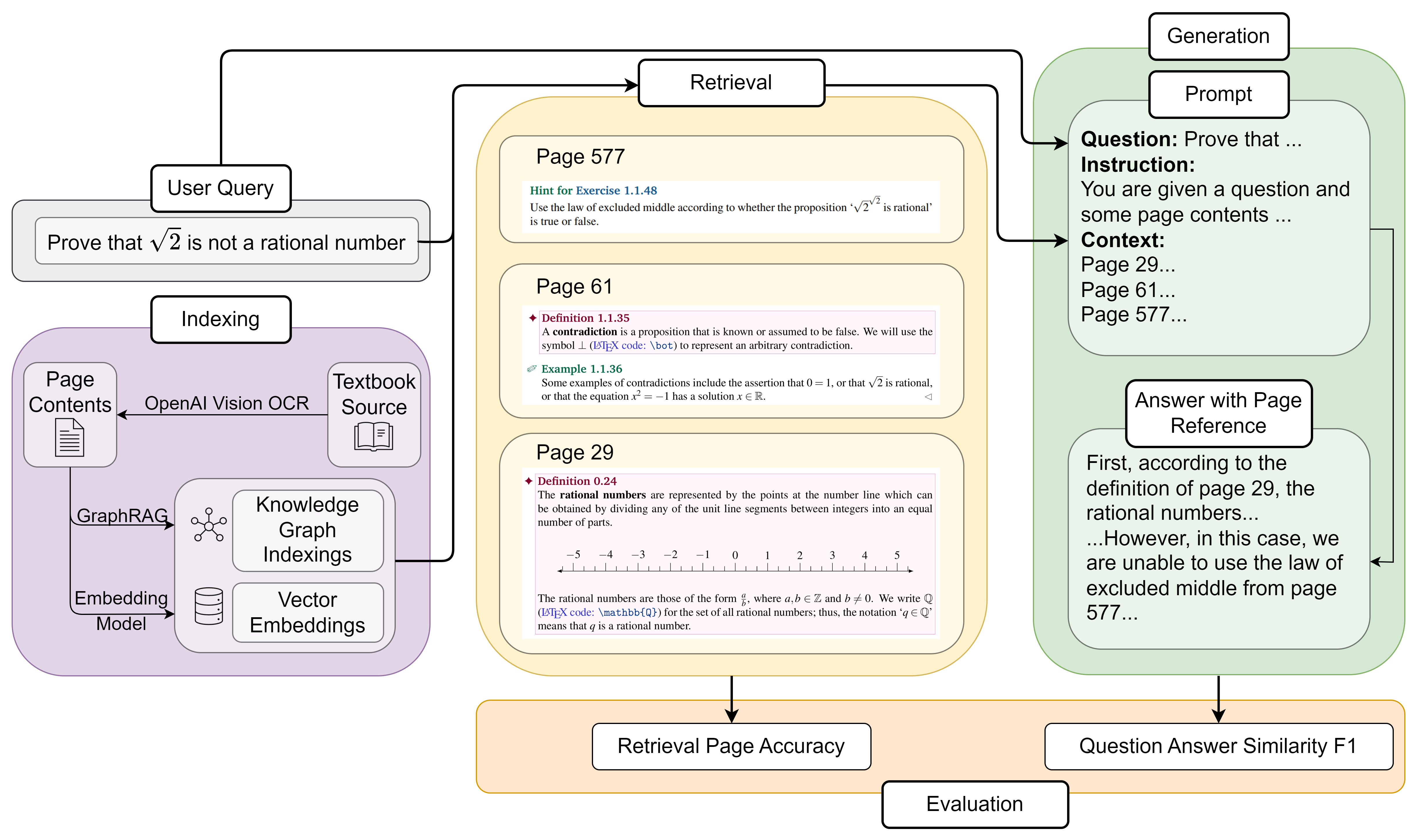
Figure 1 illustrates our pipeline, consisting of three stages: (1) Indexing, where pages are embedded as vectors (RAG), indexed as term-frequency vectors (BM25), or encoded as relational entities (GraphRAG); (2) Retrieval, where the top-\(k\) most relevant pages or entities are identified; and (3) Generation, where the query, prompt, and retrieved content are fed to an LLM for answer generation.
2.3 Models and Baselines
We selected five embedding models from the December
2024 Massive Text Embedding Benchmark (MTEB)
leaderboard [22, 14]: voyage-3-large and nv-embed-v2 were
chosen for their high rankings; gte-large is commonly
used as a fine-tuning base; text-embedding-3-large was
included for its widespread adoption; and multilingual-e5
for its multilingual capabilities. We also include a BM25
sparse-retrieval baseline using Okapi BM25 with default
parameters, to contextualize neural embedding gains against a
classical term-matching approach that requires no training or
fine-tuning. For each model, we tested retrieval at \(k \in \{1, 3, 5, 10\}\).
For GraphRAG [8], we adapted the framework to expose
document_ids for each entity and text unit, enabling page-level
traceability. Specifically, we modified various GraphRAG
components to store and output fields such as document_ids
and entity_ids, allowing our system to link each retrieved item
back to a corresponding page number. We tested GraphRAG
with both gpt-4o-mini and o3-mini as the underlying LLM.
Note that since GraphRAG retrieves entire entities and
community summaries rather than ranked pages, we cannot
directly control the number of pages returned; accuracy is
evaluated based on whether the correct page’s entities appear in
the retrieved data.
2.4 Evaluation Metrics
We evaluate with two metrics: (1) Retrieval Accuracy, whether
the correct source page appears in the retrieved set, averaged
across all 477 queries; and (2) F1 Score, word-overlap F1
between the generated answer (produced by gpt-4o-mini given
retrieved context) and the ground-truth answer. The F1
score captures the balance between precision (fraction of
generated words appearing in the reference) and recall
(fraction of reference words appearing in the generated
output). We report bootstrap 95% confidence intervals (10,000
resamples) for key comparisons to assess statistical significance.
We also conducted an error analysis of retrieval failures,
categorizing top-1 misses by page distance and chapter
membership to understand whether failures are near-misses or
far-misses. Additionally, we tested LLM-based re-ranking
of retrieved pages using gpt-4o-mini, where the model
reorders retrieved pages by estimated relevance to the
query.
3. RESULTS
3.1 Retrieval Accuracy
Table 1 presents retrieval accuracy results. Among all models,
voyage-3-large achieves the highest accuracy across all top-\(k\)
settings, reaching 99.4% at top-10. Bootstrap 95% CIs for
top-1 accuracy confirm that voyage-3-large ([.644, .728])
significantly outperforms nv-embed-v2 ([.541, .629]), as these
intervals do not overlap at top-1 or top-3.
BM25 proves a strong sparse-retrieval baseline, achieving top-1
accuracy of .579, outperforming both gte-large (.461) and
multilingual-e5 (.457) at all \(k\) values despite using no
learned representations. This highlights the importance of
including classical baselines in retrieval evaluations. Despite
strong MTEB leaderboard rankings, multilingual-e5
underperformed on this domain-specific task, underscoring that
benchmark performance does not always transfer to specialized
mathematical domains.
GraphRAG achieves 84.5% with gpt-4o-mini and 91.4% with
o3-mini. All five embedding models surpass GraphRAG’s
accuracy at top-5 or above. The gap between the two
GraphRAG configurations suggests that the underlying
LLM quality substantially affects graph-based retrieval
performance.
| Model | Top-1 | Top-3 | Top-5 | Top-10 |
|---|---|---|---|---|
| voyage-3-large | .686 | .910 | .958 | .994 |
| nvidia/nv-embed-v2 | .585 | .843 | .912 | .964 |
| BM25 | .579 | .780 | .855 | .929 |
| OpenAI emb-3-large | .549 | .811 | .893 | .933 |
| gte-large | .461 | .711 | .799 | .881 |
| multilingual-e5 | .457 | .702 | .795 | .870 |
| GraphRAG (o3-mini) | .914
| |||
| GraphRAG (4o-mini) | .845
| |||
3.2 Generated Answer Quality
Table 2 shows F1 scores for answer generation. The no-retrieval
baseline (gpt-4o-mini alone) achieves 0.475. All RAG
configurations improve upon this, with F1 scores ranging from
0.514 to 0.552, confirming that retrieval grounding consistently
benefits domain-specific QA. GraphRAG achieves F1 of \(\sim \)0.524,
comparable to but slightly below the best embedding-based
results.
Interestingly, nv-embed-v2 achieves the highest top-1 F1 (.537)
despite lower retrieval accuracy than voyage-3-large,
suggesting retrieval accuracy and generation quality do not
always correlate, because near-miss retrievals still provide useful
context. Increasing \(k\) generally does not improve F1, as
additional pages introduce noise. GraphRAG’s \(\sim \)47K tokens of
context per query (vs. \(\sim \)3.7K for top-5 RAG) overwhelms the
generator, suggesting that retrieval precision matters more than
recall for generation quality.
| Model | Top-1 | Top-3 | Top-5 | Top-10 |
|---|---|---|---|---|
| voyage-3-large | .523 | .543 | .544 | .547 |
| nvidia/nv-embed-v2 | .537 | .542 | .541 | .539 |
| OpenAI emb-3-large | .531 | .549 | .533 | .543 |
| gte-large | .526 | .533 | .550 | .552 |
| multilingual-e5 | .514 | .534 | .541 | .535 |
| GraphRAG (o3-mini) | .524
| |||
| GraphRAG (4o-mini) | .525
| |||
| No retrieval | .475
| |||
3.3 Re-Ranking
LLM-based re-ranking with gpt-4o-mini yielded mixed results.
Re-ranking top-5 pages degraded voyage-3-large’s top-1
accuracy from .686 to .593, while re-ranking top-10 caused
further degradation across all models. Critically, we observed
hallucinated page numbers in re-ranking outputs: the LLM
occasionally referenced pages not in the retrieved set. These
findings suggest that LLM-based re-ranking is unreliable
for page-level retrieval, particularly with larger candidate
sets.
3.4 Error Analysis
We examined the 150 top-1 failures from voyage-3-large,
categorizing each by page distance and chapter membership. Of
these, 46.0% retrieved an adjacent page (distance \(\leq \) 2), 17.3%
retrieved a same-chapter but non-adjacent page, and 35.3% were
far misses (different chapter). Overall, 63.3% of failures
retrieved same-chapter content, with a median page distance of
just 3 pages. This suggests that even “incorrect” retrievals often
surface pedagogically relevant material. For example, a student
asking about a proof may be directed to the adjacent page
containing the theorem statement, content that is still
valuable for building understanding and that an instructor
might recommend reviewing first. The high proportion of
near-misses reflects the textbook’s pedagogical structure,
where definitions, theorems, and proofs are deliberately
organized across consecutive pages to support incremental
learning. The 35.3% far misses, where shared terminology
across chapters causes cross-topic confusion, represent
the genuinely problematic failures that could misdirect
students.
3.5 Open-Source LLM Replication
To assess whether our findings generalize beyond commercial
APIs, we replicated key experiments using Qwen3.5-35B-A3B [30],
an open-source 36B Mixture-of-Experts model running locally
on 2\(\times \) NVIDIA TITAN RTX GPUs with Q4_K_M quantization
via Ollama. For retrieval, we tested nomic-embed-text [25], an
open-source embedding model, also served locally.
Table 3 compares generation quality (F1) between the
commercial gpt-4o-mini and the local Qwen3.5 setup. Without
retrieval, Qwen3.5 achieves substantially lower F1 (0.276
vs. 0.475). However, adding RAG with nomic-embed-text
retrieval improves Qwen3.5’s F1 to 0.384, a 39% relative
improvement, compared to only 16% for gpt-4o-mini with its
best embedding model. This suggests that weaker models benefit
disproportionately from retrieval grounding, as they rely more heavily on external context to compensate for limited
parametric knowledge.
| Configuration | gpt-4o-mini | Qwen3.5-35B |
|---|---|---|
| No retrieval | 0.475 | 0.276 |
| Best RAG + generation | 0.552 | 0.384 |
| Relative improvement | +16% | +39% |
For retrieval accuracy, nomic-embed-text achieved top-1
accuracy of 45.1%, top-3 of 71.3%, and top-10 of 88.7%,
below the best commercial embeddings but still serviceable.
Notably, BM25 (61.2% top-1) again outperforms this neural
embedding model, reinforcing BM25’s strength as a zero-cost
baseline.
We also attempted GraphRAG v3.0.6 indexing with Qwen3.5, successfully extracting 4,528 entities, 10,828 relationships, and 1,107 communities. However, query-time generation failed due to incompatibilities between GraphRAG’s OpenAI-compatible API expectations and Qwen3.5’s thinking-mode architecture. This demonstrates that while local LLM indexing for GraphRAG is feasible, end-to-end integration with open-source models remains challenging.
4. DISCUSSION AND CONCLUSION
Our findings yield several key insights for designing RAG-based educational AI systems.
RAG consistently improves over baseline LLMs. All RAG configurations produced higher F1 scores than the no-retrieval baseline (0.475 vs. 0.514 to 0.552), confirming that grounding LLM responses in textbook content improves answer quality for domain-specific question answering. This improvement is meaningful in educational settings where students benefit from answers grounded in their assigned course materials rather than the LLM’s general pre-training data, which may contain incorrect or outdated mathematical content [3, 2].
Embedding-based RAG outperforms GraphRAG for page-level retrieval. GraphRAG retrieves excessive context (\(\sim \)47K tokens vs. \(\sim \)3.7K for top-5 RAG), leading to lower precision and comparable or lower F1 [28, 32]. This reflects a task-method mismatch: GraphRAG was designed for global summarization and multi-hop reasoning, not page-level lookup. For educational applications where students need a specific page reference, the simpler embedding-based approach is more appropriate. However, GraphRAG may excel at cross-concept questions (e.g., “How do induction and well-ordering relate across chapters?”) where its entity-based structure could surface connections that page-level retrieval would miss.
BM25 is a competitive baseline. BM25 outperforms two of five embedding models at all \(k\) values, partly due to high lexical overlap (72% unigram) between questions and source pages. This underscores the importance of including classical baselines, as neural embeddings do not always yield proportional gains, particularly when questions and documents share substantial vocabulary.
Most retrieval failures are near-misses with pedagogical value. Our error analysis reveals that 63.3% of top-1 failures retrieve same-chapter content (median distance: 3 pages). From an educational perspective, this means a student directed to the “wrong” page is still reading closely related material in most cases, analogous to how a tutor might say “look at the previous page first” before addressing the specific question. The top-1 accuracy of 68.6% may appear insufficient, but the near-miss pattern means the system rarely sends students to entirely irrelevant content.
Re-ranking introduces more risk than benefit. LLM-based re-ranking degraded performance for top-performing retrievers and introduced hallucinated page references, suggesting general-purpose LLMs struggle to distinguish between mathematically similar pages. Deployments requiring re-ranking should explore fine-tuned cross-encoder models or constrained decoding.
Open-source LLMs are viable but benefit more from RAG. RAG provides proportionally larger gains for weaker models (+39% vs. +16% relative F1 improvement), suggesting that retrieval grounding partially compensates for reduced model capability. This is significant for educational settings where commercial API costs are prohibitive, and aligns with EDM 2026’s “Across Borders” theme, because institutions can deploy useful textbook-grounded QA systems on local hardware rather than relying on commercial APIs. Our results show that a locally hosted open-source model combined with BM25 retrieval (requiring no GPU for the retrieval component) can deliver meaningful QA quality at near-zero marginal cost.
Practical recommendations. (1) Use top-5 RAG retrieval as default (accuracy .958, \(\sim \)3.7K tokens); (2) present top-3 candidate pages to students (accuracy \(>\)91%); (3) avoid LLM re-ranking due to hallucination risk; (4) consider adjacent-page windowing to capture theorem-proof pairs spanning page boundaries.
Limitations and Future Work. While questions were curated by
course-familiar authors to reflect realistic student queries,
their high lexical overlap with source pages (72% unigram)
may inflate retrieval accuracy relative to more diverse
student phrasings; future work should supplement with
authentic questions from discussion forums or office
hours. Word-overlap F1 is a weak proxy for math QA, as
mathematically equivalent expressions can score poorly;
LLM-as-judge or symbolic equivalence checking would
better capture correctness. Extending to multiple STEM
textbooks, investigating hybrid BM25+dense retrieval, and
conducting classroom studies measuring whether page references
improve comprehension and student trust are important
next steps. Notably, multilingual-e5’s underperformance
despite strong general benchmarks raises questions about
deploying these systems for non-English textbooks, an
important consideration for educational equity across linguistic
borders.
5. REFERENCES
- T. Brown, B. Mann, N. Ryder, M. Subbiah, J. D. Kaplan, P. Dhariwal, A. Neelakantan, P. Shyam, G. Sastry, A. Askell, et al. Language models are few-shot learners. Advances in neural information processing systems, 33:1877–1901, 2020.
- E. Chen, S. Judicke, K. Beigh, X. Tang, I. Wang, N. Yuan, Z. Xiao, C. Li, S. Li, R. Luttmer, S. Singh, and K. R. Koedinger. Chat-based support alone may not be enough: Comparing conversational and embedded llm feedback for mathematical proof learning. arXiv preprint arXiv:2602.18807, 2026.
- E. Chen, S. Judicke, K. Beigh, X. Tang, Z. Xiao, C. Li, S. Li, R. Luttmer, S. Singh, and K. R. Koedinger. Generative ai alone may not be enough: Evaluating ai support for learning mathematical proof. arXiv preprint arXiv:2509.16778, 2025.
- E. Chen, D. Wang, L. Xu, C. Cao, X. Fang, and J. Lin. A systematic review on prompt engineering in large language models for k-12 stem education. arXiv preprint arXiv:2410.11123, 2024.
- X. Chen, S. Jia, and Y. Xiang. A review: Knowledge reasoning over knowledge graph. Expert systems with applications, 141:112948, 2020.
- S. Chiesurin, D. Dimakopoulos, M. A. Sobrevilla Cabezudo, A. Eshghi, I. Papaioannou, V. Rieser, and I. Konstas. The dangers of trusting stochastic parrots: Faithfulness and trust in open-domain conversational question answering. In A. Rogers, J. Boyd-Graber, and N. Okazaki, editors, Findings of the Association for Computational Linguistics: ACL 2023, pages 947–959, Toronto, Canada, July 2023. Association for Computational Linguistics.
- W. Dai, Y.-S. Tsai, J. Lin, A. Aldino, H. Jin, T. Li, D. Gašević, and G. Chen. Assessing the proficiency of large language models in automatic feedback generation: An evaluation study. Computers and Education: Artificial Intelligence, 7:100299, 2024.
- D. Edge, H. Trinh, N. Cheng, J. Bradley, A. Chao, A. Mody, S. Truitt, and J. Larson. From local to global: A graph rag approach to query-focused summarization, 2024.
- T. Feng, S. Liu, and D. Ghosal. Courseassist: Pedagogically appropriate ai tutor for computer science education, 2024.
- Y. Gao, Y. Xiong, X. Gao, K. Jia, J. Pan, Y. Bi, Y. Dai, J. Sun, M. Wang, and H. Wang. Retrieval-augmented generation for large language models: A survey, 2024.
- A. Ghiriti, W. Göderle, and R. Kern. Exploring the capabilities of gpt4-vision as ocr engine. In International Conference on Theory and Practice of Digital Libraries, pages 3–12. Springer, 2024.
- Z. F. Han, J. Lin, A. Gurung, D. R. Thomas, E. Chen, C. Borchers, S. Gupta, and K. R. Koedinger. Improving assessment of tutoring practices using retrieval-augmented generation. arXiv preprint arXiv:2402.14594, 2024.
- X. He, Y. Tian, Y. Sun, N. Chawla, T. Laurent, Y. LeCun, X. Bresson, and B. Hooi. G-retriever: Retrieval-augmented generation for textual graph understanding and question answering. Advances in Neural Information Processing Systems, 37:132876–132907, 2024.
- Hugging
Face.
MTEB
leaderboard.
https://huggingface.co/spaces/mteb/leaderboard, 2025. [Accessed 20-12-2024]. - Z. Ji, N. Lee, R. Frieske, T. Yu, D. Su, Y. Xu, E. Ishii, Y. J. Bang, A. Madotto, and P. Fung. Survey of hallucination in natural language generation. ACM computing surveys, 55(12):1–38, 2023.
- G. Lang and T. Gürpınar. AI-Powered Learning Support: A study of retrieval-augmented generation (RAG) chatbot effectiveness in an online course. Information Systems Education Journal, 23(2):4–13, 2025.
- Z. Levonian, C. Li, W. Zhu, A. Gade, O. Henkel, M.-E. Postle, and W. Xing. Retrieval-augmented generation to improve math question-answering: Trade-offs between groundedness and human preference, 2023.
- H. Li, T. Xu, C. Zhang, E. Chen, J. Liang, X. Fan, H. Li, J. Tang, and Q. Wen. Bringing generative ai to adaptive learning in education. arXiv preprint arXiv:2402.14601, 2024.
- J. Lin, S. Mai, B. Bu, M. He, and X. Wang. Research on the application of stem practical teaching based on rag knowledge graph and large models. In 7th International Conference on Educational Technology Management, pages 520–527, 2024.
- C. Mitra, M. Miroyan, R. Jain, V. Kumud, G. Ranade, and N. Norouzi. Retllm-e: Retrieval-prompt strategy for question-answering on student discussion forums. In Thirty-Eighth AAAI Conference on Artificial Intelligence (AAAI-24), 2024.
- S. Moore, H. A. Nguyen, N. Bier, T. Domadia, and J. Stamper. Assessing the quality of student-generated short answer questions using gpt-3. In European conference on technology enhanced learning, pages 243–257. Springer, 2022.
- N. Muennighoff, N. Tazi, L. Magne, and N. Reimers. Mteb: Massive text embedding benchmark. arXiv preprint arXiv:2210.07316, 2022.
- C. Newstead. An Infinite Descent into Pure Mathematics. 2024. Last updated on Wednesday 29th May 2024.
- H. A. Nguyen, H. Stec, X. Hou, S. Di, and B. M. McLaren. Evaluating chatgpt’s decimal skills and feedback generation in a digital learning game. In European conference on technology enhanced learning, pages 278–293. Springer, 2023.
- Z. Nussbaum, J. X. Morris, B. Duderstadt, and A. Mulyar. Nomic embed: Training a reproducible long context text embedder. arXiv preprint arXiv:2402.01613, 2024.
- OpenAI.
Openai
vision
model
documentation.
https://platform.openai.com/docs/guides/vision, 2024. [Accessed 20-02-2025]. - e. a. OpenAI. Gpt-4 technical report, 2024.
- B. Peng, Y. Zhu, Y. Liu, X. Bo, H. Shi, C. Hong, Y. Yan, and Y. Li. Graph retrieval-augmented generation: A survey. ACM Transactions on Information Systems, 2025.
- A. Scarlatos, D. Smith, S. Woodhead, and A. Lan. Improving the validity of automatically generated feedback via reinforcement learning. In International Conference on Artificial Intelligence in Education, pages 280–294. Springer, 2024.
- Q. Team. Qwen3.5 technical report, 2026. Accessed: 2026-03-28.
- S. Wang, T. Xu, H. Li, C. Zhang, J. Liang, J. Tang, P. S. Yu, and Q. Wen. Large language models for education: A survey and outlook, 2024.
- Q. Zhang, S. Chen, Y. Bei, Z. Yuan, H. Zhou, Z. Hong, J. Dong, H. Chen, Y. Chang, and X. Huang. A survey of graph retrieval-augmented generation for customized large language models. arXiv preprint arXiv:2501.13958, 2025.
- C. Q. Zhao, J. Cao, E. Chen, K. R. Koedinger, and J. Lin. Slideitright: Using ai to find relevant slides and provide feedback for open-ended questions. In International Conference on Artificial Intelligence in Education, pages 378–392, 2025.
© 2026 Copyright is held by the author(s). This work is distributed under the Creative Commons Attribution-NonCommercial-NoDerivatives 4.0 International (CC BY-NC-ND 4.0) license.