Examining Expert-Novice Differences in
Online Team Formation
ABSTRACT
Crowdsourcing platforms like Kaggle provide community-driven mechanisms for team formation and informal learning, yet little is known about how these mechanisms operate across expertise levels. We analyze 1,577 comments from 671 participants across 18 Kaggle “Looking for a Team” megathreads (2023) and identify a systematic attention imbalance by expertise level. Low-tier users (Novice and Contributor) constitute 89.3% of participants, yet higher-tier users attract disproportionate attention in the reply network (\(H = 16.46\), \(p = .003\)). Dyadic regression further confirms that receiver expertise predicts tie formation (OR \(= 1.28\)), consistent with preferential attachment. Using linked final team records for 16 competitions, however, we do not observe a statistically significant expertise gap in ending on a multi-member team (41.0% for low-tier vs. 34.7% for high-tier user-competition observations, \(\chi ^2 = 1.26\), \(p = .261\)). These results show that megathreads reproduce expertise-based differences in visibility more clearly than in observed final team membership. We identify preferential attachment as a key mechanism underlying this visibility imbalance and translate our findings into design recommendations for more equitable team formation systems.
Keywords
1. INTRODUCTION
Crowdsourcing platforms such as Kaggle have evolved beyond task completion into spaces for professional development and informal learning [2, 12]. As crowdsourcing tasks grow in complexity, collaboration has become essential, encouraging knowledge workers to form teams to tackle data science challenges [6]. The first step of collaboration is team formation, a process that unfolds differently in virtual communities than in traditional organizations because individuals have the autonomy to choose their own collaborators [5].
To facilitate this process, platforms provide spaces for team-seeking behavior. Kaggle’s “Looking for a Team” (L4T) megathreads, introduced in 2022, are competition-specific forums where participants post team-seeking messages and reply to potential collaborators [18]. While prior work has examined the general dynamics of megathread conversations and self-representation patterns [18], a critical question remains: who actually benefits from these spaces?
This question has equity implications. If these spaces disproportionately serve users who already have established networks and credentials, they may widen the gap between experts and newcomers rather than close it [7]. We address three research questions:
- RQ1. How does expertise level relate to participation patterns and network position?
- RQ2. What network mechanisms (preferential attachment and homophily) drive tie formation?
- RQ3. Do expert and novice users benefit equally from megathread participation?
Drawing on preferential attachment [1] and homophily [11], we hypothesize that higher-tier users attract a disproportionate share of replies in team-seeking forums and that this visibility advantage may carry over into observed team membership outcomes.
2. RELATED WORK
Group Formation in Online Communities. Research on group formation distinguishes automatic from agency-driven approaches across different contexts [5]. In MOOCs, automatic grouping by activity or demographics can improve satisfaction [14, 19], but such automation potentially removes individual agency. In open communities like Kaggle, human agency dominates. Participants actively seek information about potential collaborators before forming teams [10]. Language proficiency and past collaborations predict team-up decisions positively on Kaggle, while geographical distance and skill disparity show negative effects [3]. However, most studies assume pre-formed teams rather than examining how teams naturally emerge in these communities [6].
Expert-Novice Differences in Crowdsourcing Communities. Crowdsourcing platforms such as Kaggle make expertise visible through status hierarchies: the performance tier system publicly labels users from Novice, Contributor, Expert, Master, to Grandmaster, and these labels travel with users into team-seeking interactions. Prior work has shown that newcomers in open-source communities face barriers to gaining trust and attracting collaboration [10], and that sharing online profiles and expertise signals predicts collaboration success [13]. What remains underexplored is whether team formation spaces specifically designed to help all users actually achieve equitable outcomes across expertise levels.
Preferential Attachment, Homophily, and Marginality. Preferential attachment, the tendency for well-connected nodes to attract yet more connections [1], and homophily, the tendency for similar individuals to associate [11], are two fundamental mechanisms in social network formation. Wang [17] has argued that marginality, defined as being located at the periphery of a network, might form a team easier than more experienced users in crowdsourcing contexts. Twyman et al. [15] found that network positioning shapes Kaggle competition performance, while Li et al. [9] showed social influence effects in this community. We extend this work by examining how these mechanisms manifest in team-seeking online forums and whether they produce inequitable outcomes for novices.
3. METHODS
3.1 Data Collection
We collected data from Kaggle’s official L4T megathreads for all competitions held in 2023 using the Kaggle API. Of 31 competitions identified, 18 featured L4T megathreads created by Kaggle staff. Our dataset comprises two components: (1) megathread comments, totaling 1,577 from 676 unique users across the 18 competitions, and (2) user profiles for 671 users matched to Kaggle’s performance tier system (99.3% match rate, five participants do not have a profile).
Kaggle’s performance tier system assigns users a tier from 0 (Novice, no activity) to 4 (Grandmaster), with tier 5 reserved for Kaggle Staff. Tiers are awarded based on cumulative competition medals: Novice (no medals), Contributor (profile complete), Expert (\(\geq \)2 bronze medals), Master (\(\geq \)1 gold + 3 silver), and Grandmaster (\(\geq \)5 gold including a solo gold). We operationalize expertise using this tier and create a binary split: Low-Tier (Novice and Contributor, tiers 0–1, indicating no or minimal verified competition achievement) and High-Tier (Expert through Grandmaster, tiers 2–4, indicating at least two verified competition medals).
3.2 Data Analysis
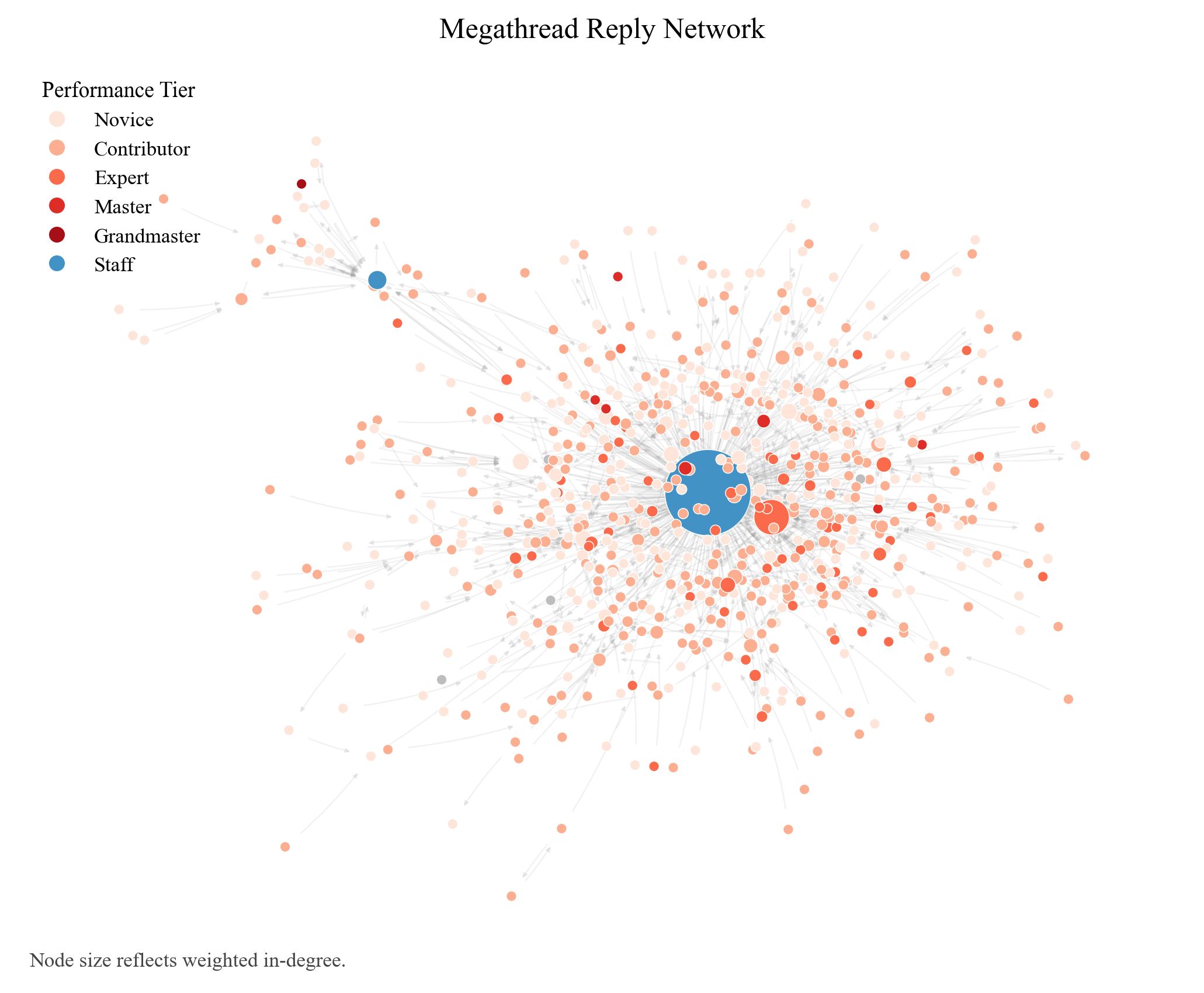
Our analysis proceeds in five stages. First, we constructed a directed reply network from the megathread data using NetworkX [4]. Each node represents a user, and a directed edge from \(A\) to \(B\) indicates that user \(A\) replied to a comment posted by user \(B\). Edge weights represent the number of replies between a pair. The resulting network contains 665 nodes and 1,300 directed edges (density = 0.003). Figure 1 visualizes the reply network, with node color indicating Kaggle performance tier and node size reflecting weighted in-degree (replies received).
Then, we characterized the expertise composition of megathread participants and their comment activity patterns through a tier distribution analysis. Third, we computed in-degree (replies received), out-degree (replies sent), and betweenness centrality for each node, then compare distributions across tiers using Kruskal-Wallis tests. Then, we tested for preferential attachment by comparing the proportion of replies received by each tier against their population share with a chi-squared goodness-of-fit test, and for homophily by computing the E-I index [8], defined as the ratio of cross-tier to within-tier edges, with significance assessed via a permutation test (1,000 permutations). Finally, we fit a dyadic logistic regression that models tie formation as a function of sender tier, receiver tier, tier difference, same-tier indicator, and account tenure, sampling negative dyads at a 3:1 ratio and evaluating with five-fold cross-validation.
3.3 Team-up Success Operationalization
We use a linked competition-team file that connects megathread
participants to final team records for 16 competitions. Success
is defined as ending on a multi-member team in a given
competition (i.e., NumbersPlayer \(> 1\)). This linked subset contains
382 user-competition observations from 219 unique users, of
which 377 observations have matched tier labels. This
measure captures observed final team membership directly, in
contrast to indirect signals such as medal counts or reciprocal
replies.
4. RESULTS
4.1 RQ1: Expertise and Participation
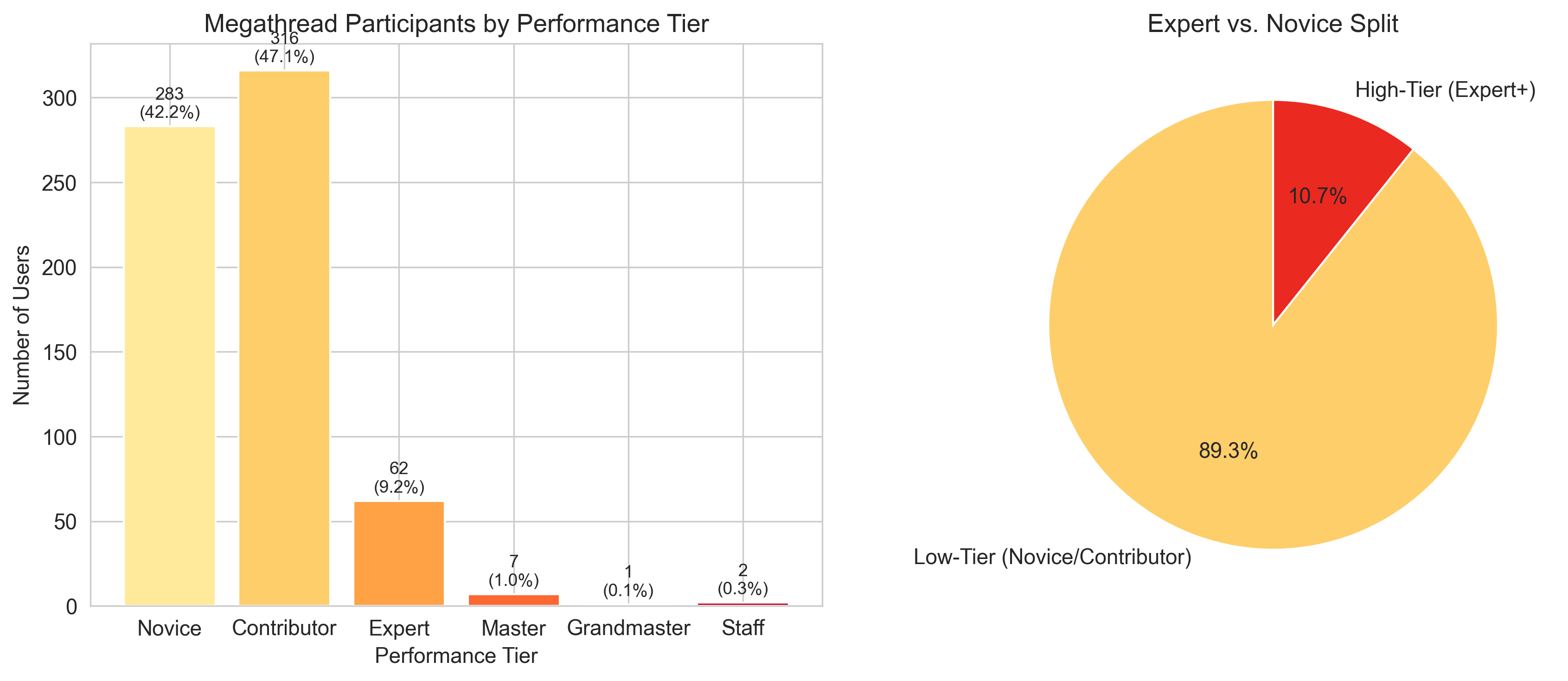
The megathread participant pool is heavily skewed toward lower tiers. As shown in Figure 2, Novice users (tier 0) comprise 42.2% of participants and Contributors (tier 1) comprise 47.1%, yielding a combined low-tier share of 89.3%. Expert users (tier 2) account for only 9.2%, with Master (1.0%) and Grandmaster (0.1%) users nearly absent.
Despite their minority presence, higher-tier users occupy more central network positions. Expert users receive significantly more replies (mean in-degree = 3.32) compared to Novice (1.39) and Contributor (1.43) users, with a statistically significant difference across tiers (Kruskal-Wallis \(H=16.46\), \(p=.003\)). Betweenness centrality also differs significantly (\(H=16.09\), \(p=.003\)), with Expert users serving as more central bridges in the network. However, out-degree does not differ significantly (\(H=3.82\), \(p=.431\)), indicating that all tiers send a similar number of replies but receive attention unevenly.
4.2 RQ2: Attachment and Homophily
Preferential attachment. Table 1 compares population share with reply-target share. Excluding Staff (who post the initial megathread announcements), Expert users receive \(1.51\times \) their population share in replies, while both Novice (\(0.62\times \)) and Contributor (\(0.63\times \)) users receive less than their expected share. A chi-squared test confirms this disproportionality is significant (\(p < .001\)), supporting preferential attachment toward higher-tier users.
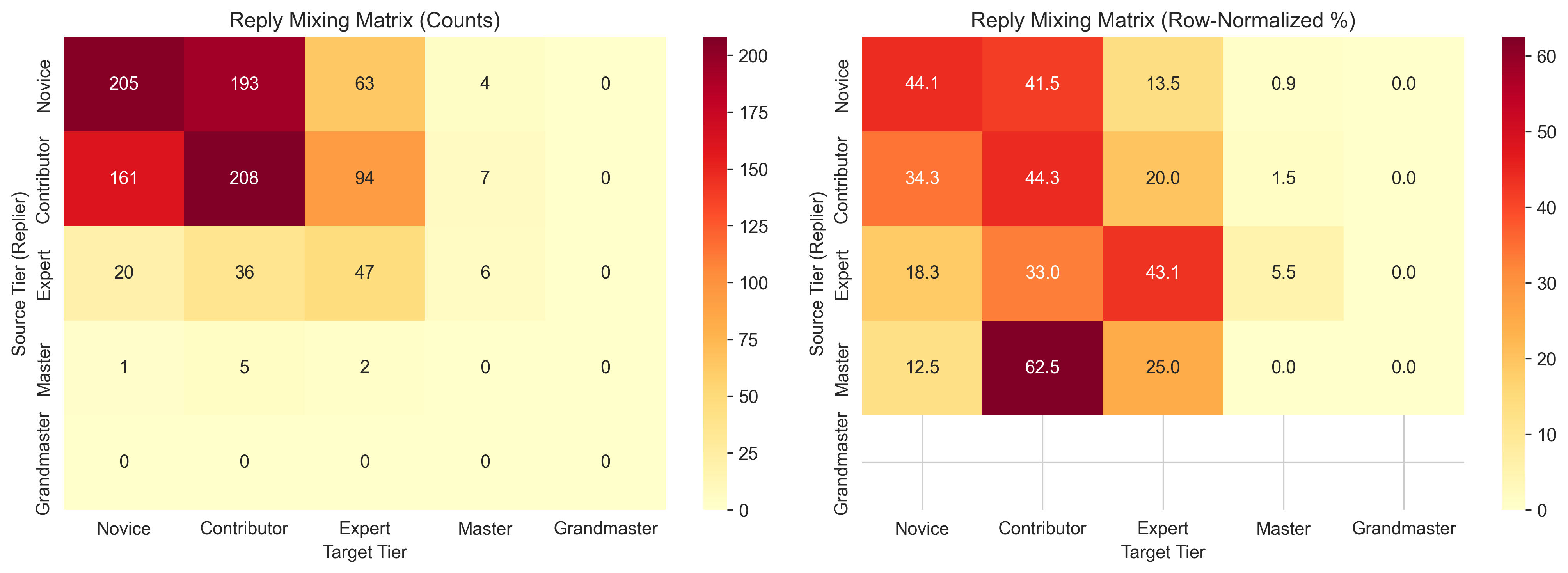
Homophily. The E-I index of 0.125 shows slightly more interaction across tiers than within them, consistent with novices reaching out to experienced users. The permutation test yields \(p = .062\), which does not reach conventional significance (\(\alpha = .05\)), which should be treated as suggestive rather than conclusive. The trend points toward upward-directed attention, but a larger sample is needed before claiming a confirmed homophily effect. Figure 3 shows the reply mixing matrix; low-tier users direct a substantial share of replies toward Staff-initiated threads and cross-tier targets.
Dyadic regression. The logistic regression model achieves a five-fold cross-validated AUC of 0.558. The receiver’s tier has a positive coefficient (OR \(=1.28\)), confirming that higher-tier users attract more connections. Tier difference has a negative coefficient (OR \(=0.83\)), indicating that larger expertise gaps slightly reduce tie formation probability. The overall model performance is modest, which is expected for sparse social networks, but the direction and significance of the coefficients support both preferential attachment and weak homophily effects.
4.3 RQ3: Differential Success Rates
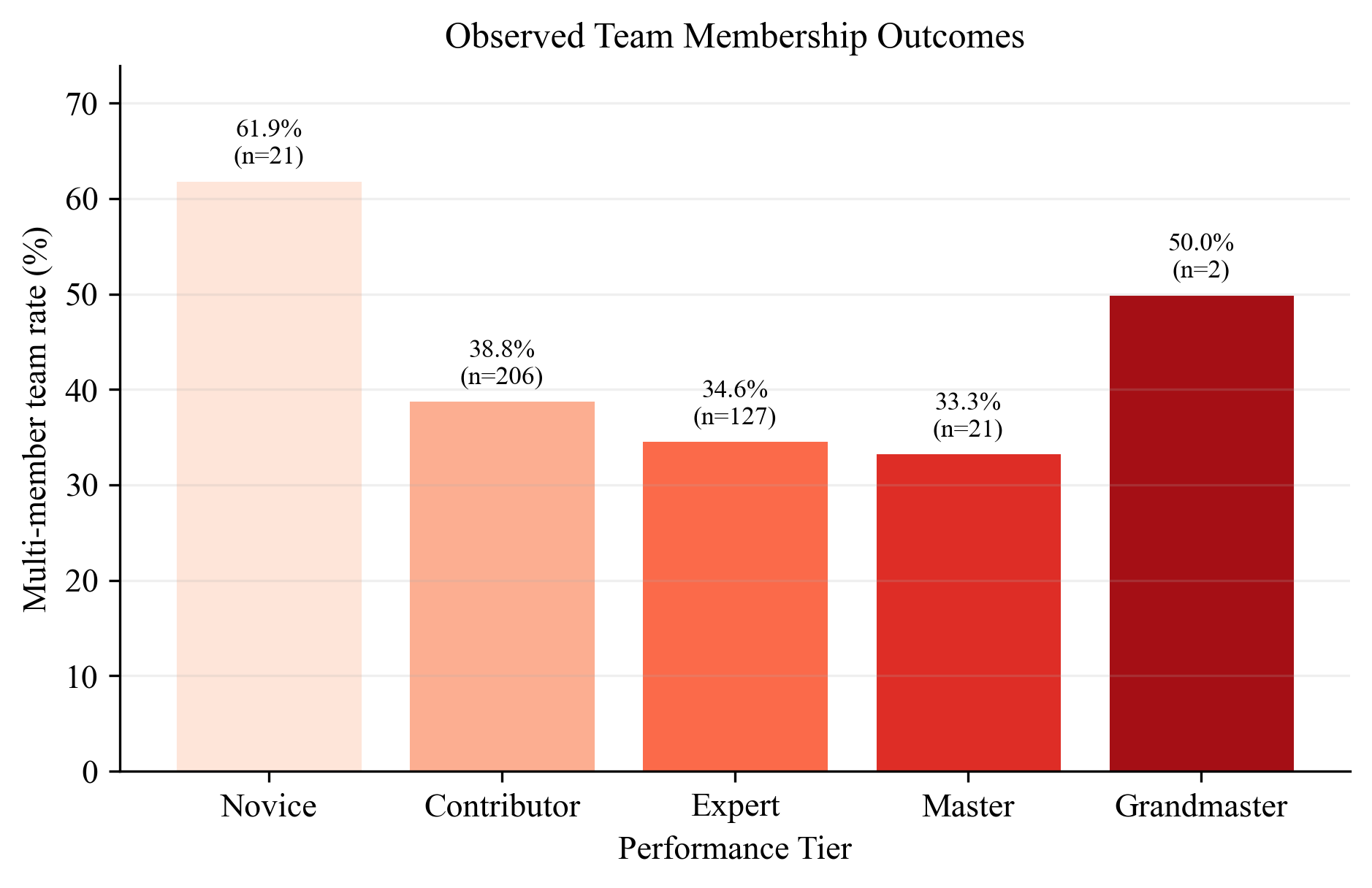
Using the linked team-membership data, we do not find a statistically significant expertise gap in final teaming outcomes. As shown in Figure 4, low-tier user-competition observations end on multi-member teams in 41.0% of cases, compared with 34.7% for high-tier observations; this difference is not statistically significant (\(\chi ^2=1.26\), \(p=.261\)).
5. DISCUSSION
5.1 Attention Inequality and Team Outcomes
Our findings reveal a mixed pattern. Megathreads are populated mainly by low-tier users, but higher-tier users receive more attention once interaction begins. While higher-tier users receive more attention, they do not necessarily convert that attention into more frequent teaming outcomes, as the multi-member team rates do not differ significantly by tier. Preferential attachment seems only to reproduce inequality in visibility more clearly than in observed final teaming outcomes. Therefore, the megathread mechanism appears to amplify visibility disparities without necessarily translating them into a significant teaming gap, suggesting that the relationship between visibility and teaming is complex and mediated by other factors [10].
5.2 Why Visibility Does Not Map Onto Teaming
Several mechanisms can explain this misalignment. First, low-tier users overwhelmingly outnumber high-tier users (89.3% vs. 10.7%), so even when high-tier users attract proportionally more replies, the absolute volume of low-tier participants leaves opportunity for novices to find one another and form teams among themselves. Second, attention is not the same as acceptance. High-tier users who received many replies may decline most invitations, screen for quality, or already have established collaborators outside the megathread, so the replies they receive do not necessarily convert into joint team registrations [15]. Third, megathreads are only one of several channels through which Kaggle teams form. Teammates can be recruited via private messages, off-platform networks, or prior competitions, and these channels likely distribute more evenly across tiers than the public reply network does. These dynamics suggest that the visibility imbalance is real and consequential for whose contributions get seen, but it is buffered by the over-representation of novices and by team formation pathways that operate outside the channel.
5.3 Implications
While Wang [17] has argued that marginality is an important indicator of whether a user can form a group in crowdsourcing platform, our finding reveal a challege for novice participants in the crwodsourcing space. Reframing the finding through an equity lens, the absence of a teaming gap is not evidence that megathreads are equitable. Visibility shapes whose questions are answered, whose skills are recognized, and whose presence is registered by the rest of the community, all of which carry weight beyond the binary outcome of ending on a multi-member team. A novice who posts and receives no replies may eventually team with another novice, but the experience of being overlooked is itself an equity-relevant outcome that the multi-member rate alone cannot capture. This motivates design responses targeted at the visibility rather than only the final teaming layer.
Our results suggest several design implications for more equitable team formation. Platforms could provide templates that prompt users to describe their skills, learning goals, and availability, making it easier for novices to present relevant information in comparable ways [13], and temporarily anonymize tier information in team-seeking forums to reduce preferential attachment effects so that evaluation rests on stated skills rather than status labels. Because experts rarely use megathreads, platforms could also design mentorship pathways that incentivize cross-tier collaboration through recognition systems or reduced entry barriers, and offer practice collaborations before competitive events [16] so newcomers can build trust incrementally. These implications extend beyond Kaggle to other online learning communities, such as open-source development, online courses, and professional networking platforms, where similar expert-novice dynamics may exist.
5.4 Limitations
Two limitations bound the scope of our claims. First, Kaggle’s performance tier conflates platform experience with domain expertise and is partly circular: tiers are awarded for cumulative competition medals, so higher-tier users are by definition those who have already performed well, and seasoned data scientists new to Kaggle will be misclassified as novices. We treat this as a substantive feature rather than a flaw, since tier labels are the community’s shared expertise signal and our study examines how those socially recognized markers shape interaction, but readers should interpret tier as visible status rather than as ground-truth skill. Second, ending on a multi-member team is a coarse outcome that does not establish that the team was actually formed through the megathread, and it does not capture collaboration quality. Future work should link megathread exchanges to teammate identities directly and incorporate more behavioral signals such as notebook sharing and code co-authorship.
6. CONCLUSION
We examined expert-novice differences in Kaggle’s “Looking for a Team” megathreads and found that these platform-provided team formation spaces disproportionately attract novice users while directing disproportionate attention toward higher-tier participants. Higher-tier users receive more network attention, but the linked final team records do not show a statistically significant expertise gap in observed multi-member team membership. These findings contribute to ongoing work on equity in online learning communities, showing that platform mechanisms designed for universal benefit can reproduce hierarchies in visibility even when downstream team outcomes are more mixed. We offer concrete design recommendations for creating more equitable team formation systems in competitive learning communities.
7. REFERENCES
- A.-L. Barabási and R. Albert. Emergence of scaling in random networks. Science, 286(5439):509–512, 1999.
- W. Chow. A pedagogy that uses a Kaggle competition for teaching machine learning: An experience sharing. In 2019 IEEE International Conference on Engineering, Technology and Education (TALE), pages 1–5. IEEE, 2019.
- I. Dissanayake, N. Mehta, P. Palvia, V. Taras, and K. Amoako-Gyampah. Competition matters! self-efficacy, effort, and performance in crowdsourcing teams. Information & Management, 56(8):103158–103158, 2019.
- A. Hagberg, P. Swart, and D. S. Chult. Exploring network structure, dynamics, and function using NetworkX. Technical report, Los Alamos National Lab., 2008.
- A. M. Harris, D. Gómez-Zará, L. A. DeChurch, and N. S. Contractor. Joining together online: The trajectory of CSCW scholarship on group formation. Proceedings of the ACM on Human-Computer Interaction, 3(CSCW):1–35, 2019.
- K. Huang, J. Zhou, and S. Chen. Being a solo endeavor or team worker in crowdsourcing contests? it is a long-term decision you need to make. Proceedings of the ACM on Human-Computer Interaction, 6(CSCW2):1–27, 2022.
- R. F. Kizilcec, J. Reich, M. Yeomans, C. Dann, E. Brunskill, G. Lopez, S. Turkay, J. J. Williams, and D. Tingley. Scaling up behavioral science interventions in online education. Proceedings of the National Academy of Sciences, 117(26):14900–14905, 2020.
- D. Krackhardt and R. N. Stern. Assessing the political landscape: Structure, cognition, and power in organizations. Administrative Science Quarterly, 33(2):342–369, 1988.
- X. Li, Y. Bai, and Y. Kang. Exploring the social influence of the Kaggle virtual community on the M5 competition. International Journal of Forecasting, 38(4):1507–1518, 2022.
- J. Marlow, L. Dabbish, and J. Herbsleb. Impression formation in online peer production: Activity traces and personal profiles in GitHub. In Proceedings of the 2013 Conference on Computer Supported Cooperative Work, pages 117–128. ACM, 2013.
- M. McPherson, L. Smith-Lovin, and J. M. Cook. Birds of a feather: Homophily in social networks. Annual Review of Sociology, 27(1):415–444, 2001.
- J. Polak and D. Cook. A study on student performance, engagement, and experience with Kaggle inclass data challenges. Journal of Statistics and Data Science Education, 29(1):63–70, 2021.
- R. Ren, B. Yan, and L. Jian. Show me your expertise before teaming up: Sharing online profiles predicts success in open innovation. Internet Research, 30(3):845–868, 2020.
- L. Sanz-Martínez, E. Er, A. Martínez-Monés, Y. Dimitriadis, and M. L. Bote-Lorenzo. Creating collaborative groups in a MOOC: A homogeneous engagement grouping approach. Behaviour & Information Technology, 38(11):1107–1121, 2019.
- M. Twyman, G. Murić, and W. Zheng. Positioning in a collaboration network and performance in competitions: a case study of kaggle. Journal of Computer-Mediated Communication, 28(4):1–13, 2023.
- F. L. Vinella, R. Mosch, I. Lykourentzou, and J. Masthoff. The impact of digital nudging techniques on the formation of self-assembled crowd project teams. In Proceedings of the 30th ACM Conference on User Modeling, Adaptation and Personalization, pages 265–275. ACM, 2022.
- R. Wang. Marginality and team building in collaborative crowdsourcing. Online Information Review, 44(4):827–846, 2020.
- S. Wei and R. Bi. Social network and self-representation in megathread: Group formation in a data science crowdsourcing community. In Proceedings of the 17th International Conference on Educational Data Mining, pages 434–437. International Educational Data Mining Society, 2024.
- Q. Zhang, K. L. Peck, A. Hristova, K. W. Jablokow, V. Hoffman, E. Park, and R. Y. Bayeck. Exploring the communication preferences of MOOC learners and the value of preference-based groups: Is grouping enough? Educational Technology Research and Development, 64:809–837, 2016.
© 2026 Copyright is held by the author(s). This work is distributed under the Creative Commons Attribution-NonCommercial-NoDerivatives 4.0 International (CC BY-NC-ND 4.0) license.