ABSTRACT
Accurate and unambiguous guidelines are critical for large language model (LLM) based graders, yet manually crafting these prompts is often sub-optimal as LLMs can misinterpret expert guidelines or lack necessary domain specificity. Consequently, the field has moved toward automated prompt optimization to refine grading guidelines without the burden of manual trial and error. However, existing frameworks typically aggregate independent and unstructured error samples into a single update step, resulting in “rule dilution” where conflicting constraints weaken the model’s grading logic. To address these limitations, we introduce Confusion-Aware Rubric Optimization (CARO), a novel framework that enhances accuracy and computational efficiency by structurally separating error signals. CARO leverages the confusion matrix to decompose monolithic error signals into distinct modes, allowing for the diagnosis and repair of specific misclassification patterns individually. By synthesizing targeted “fixing patches" for dominant error modes and employing a diversity-aware selection mechanism, the framework prevents guidance conflict and eliminates the need for resource-heavy nested refinement loops. Empirical evaluations on teacher education and STEM datasets demonstrate that CARO significantly outperforms existing SOTA methods. These results suggest that replacing mixed-error aggregation with surgical, mode-specific repair yields robust improvements in automated assessment scalability and precision.
Keywords
1. INTRODUCTION
The rapid shift toward personalized and competency-based learning has placed unprecedented challenges for traditional assessment frameworks. As personalized learning relies on understanding the specific needs for each learner, it necessitates high-quality formative assessment. In modern pedagogy, providing frequent and high-quality assessment feedback on students’ open-ended work is essential for diagnosing misconceptions and fostering deep conceptual understanding [2, 13, 25]. Yet these benefits are hard to deliver at scale. Constructed-response tasks, such as short answers or explanations, capture students’ reasoning more directly than multiple-choice formats, but they are substantially more time-consuming to assign and evaluate. Furthermore, they can exhibit nontrivial scorer disagreement even under rubric-based evaluation [19]. Notably, this disagreement often stems from the linguistic diversity and variability inherent in student answers. This “grading bottleneck” is reflected in teachers’ reported workloads, where scoring and correcting student work consumes a sizable share of working time across education systems [22]. As a result, educational practice often trades off authenticity for scalability by reducing the use of open-ended items or returning feedback after long delays. These compromises weaken the instructional value of assessment and motivate automated grading as a way to preserve the pedagogical benefits of constructed responses without prohibitive cost or latency [1, 18].
Traditional methods of automated grading primarily relied on hand-crafted features, such as keyword matching, latent semantic analysis (LSA), or surface-level linguistic metrics [11]. These approaches requires task-specific feature engineering and fails to capture the semantic nuances of student reasoning, resulting in rigid evaluations that often penalize creative but correct answers [10]. The advent of deep learning introduced fine-tuning techniques using encoder-based models like BERT, which significantly improved semantic understanding and scoring accuracy [9, 20]. However, these models require extensive labeled datasets for training before applicable to the new tasks, making them impractical for dynamic classroom environments where assignments change frequently. Recent advancements demonstrate that large language models (LLMs) overcome this data barrier. Unlike their predecessors, LLMs can leverage zero-shot and few-shot capabilities (i.e., they can operate effectively with little to no labeled data) to grade open-ended student responses with performance approaching human-to-human agreement levels [4]. Despite this promise, the transition from human grading to LLM-driven assessment is fraught with technical hurdles. In particular, reliability is heavily contingent on the quality of the grading prompt, with the instructions and rubric operationalization constraining the model’s decision-making [4, 14]. Simply treating a human rubric as an instruction for an LLM is often sub-optimal; human rubrics, while intuitive for expert educators, often contain linguistic ambiguities that misalign with the causal reasoning of an LLM. This “alignment gap” necessitates extensive prompt engineering, a process that is often manual and driven by iterative trial and error, making it difficult to scale [6, 28]. Consequently, the field has moved toward automated prompt optimization (APO), where algorithms iteratively refine instructions based on quantitative performance feedback [29, 6].
While state-of-the-art frameworks like GradeOpt [6] leverage reflective optimization to diagnose errors, they are limited by their naive treatment of the error signal, which incurs substantial computational overhead when searching over large prompt spaces. Specifically, these methods aggregate heterogeneous error samples into a composite feedback signal, combining distinct failure types such as hallucination, excessive strictness, and rubric misunderstanding into a single optimization step without separation. This confounding of error types leads to rule dilution. That is, by attempting to address a mixture of conflicting signals simultaneously, the optimizer generates generalized, weak instructions that fail to enforce clear decision boundaries. Consequently, to find even a marginally improved prompt, these methods rely on resource-heavy exploration, generating and evaluating large pools of candidates.
To address this, we introduce CARO (Confusion-Aware Rubric
for Optimization), a framework that achieves superior accuracy
and computational efficiency by structurally separating error
signals. We observe that grading errors are not random
mixtures, but structured clusters. CARO leverages the
confusion matrix to decompose the monolithic error signal
into distinct error modes, eliminating the inefficiency of
trying to address conflicting error types simultaneously.
Specifically, CARO targets the single dominant error mode at
each step (e.g., a specific tendency to confuse a score of 0
with 1), transforming the optimization into a structured
diagnosis-and-repair pipeline. By isolating a single, clear failure
pattern, CARO generates targeted “rule patches” that are
specific and highly effective. Contributing to its precision,
CARO produces robust prompts with significantly fewer
iterations and lower token usages compared to the existing
APO baselines. Our empirical results confirm that CARO
significantly outperforms these frameworks across multiple
datasets while utilizing the same cost-effective backbone
(GPT-4o-mini1).
2. RELATED WORK
Automated short-answer grading (ASAG)Early ASAG systems relied on hand-crafted lexical features and latent semantic analysis to predict scores [21]. The field later transitioned to neural architectures, utilizing recurrent models and Transformer encoders trained on graded corpora to capture deeper semantic dependencies [26, 12]. Despite their improved accuracy, these supervised pipelines require extensive labeled data for each specific question and lack the interpretability of rubric-based assessment. This limitation motivated the shift toward Large Language Models (LLMs), which offer zero-shot flexibility and the capacity to generate human-readable feedback alongside scores.
LLM-based grading and prompt optimizationRecent studies demonstrate that LLMs can achieve high agreement with human graders, though performance remains heavily dependent on rubric specificity and prompt design [14, 3]. While frameworks like RAG can improve domain grounding [5], the challenge of manual tuning has accelerated the adoption of Automatic Prompt Optimization (APO). APO treats instructions as trainable parameters, ranging from iterative meta-optimization in OPRO and DSPy [27, 16] to the “natural-language gradients” used in ProTeGi [23]. In the educational domain, GradeOpt applies these principles to refine grading guidelines via self-reflection [6]. However, these systems generally aggregate heterogeneous errors into a single feedback signal, often obscuring the distinct failure patterns critical for precise assessment.
3. PROBLEM FORMULATION
We formalize the task of automated rubric optimization as a discrete search problem over the space of natural language instructions. Unlike fine-tuning LLM parameters, which requires extensive labeled data and computational resources, we focus on optimizing the rubric prompt in the text space. This approach leverages the in-context learning capability of pre-trained LLMs while maintaining interpretability so that graders can inspect and validate the optimized rubric before deployment. Let \(\mathcal {D} = \{(x_n, y_n)\}_{n=1}^N\) be a dataset of student responses \(x\) and ground-truth scores \(y \in \mathcal {Y}\), where \(\mathcal {Y} = \{0, 1, \dots , K-1\}\) represents an ordinal grading scale. An LLM-based grader can be defined as a function \(f_\theta \) that estimates the probability \(P_\theta (y | x, \mathcal {P})\) of a score \(y\) given a response \(x\) and a rubric prompt \(\mathcal {P}\). The predicted score is obtained as \(\hat {y} = \arg \max _{y \in \mathcal {Y}} P_\theta (y | x, \mathcal {P})\). The objective of Automated Prompt Optimization (APO) is to identify an optimal prompt \(\mathcal {P}^*\) that maximizes a performance metric \(\mathcal {M}\) (e.g., classification accuracy or quadratic weighted kappa) over a validation dataset:
The goal of our work is to address the structural inefficiency problem of the feedback signal \(g\) when generated from aggregated error data. In the context of ordinal grading, errors are not uniform; they constitute distinct directional error modes captured by the confusion matrix \(\mathbf {C}\), where an entry \(C_{ij}\) represents the frequency of true class \(i\) being misclassified as \(j\). Existing APO frameworks typically aggregate a batch of heterogeneous error samples by mixing instances of \(i \to j\) confusion with \(k \to l\) confusion to generate a single, composite feedback signal. We define this aggregation as the source of rule dilution. By exposing multiple error modes simultaneously, such methods require the optimizer model to solve a multi-objective task that demands high reasoning capacity to disentangle competing patterns. To address this challenge, we adopt a multi-agent decomposition strategy that separates the complex task into focused sub-problems: (1) a Mode-Specific Reflector that analyzes each confusion cell \((i,j)\) independently to generate targeted feedback, and (2) a Consolidator that synthesizes per-mode refinements into a coherent, non-redundant rule set while maintaining global consistency.
Furthermore, this optimization landscape is characterized by high inter-dependency between grading criteria, leading to mode interference. Addressing a specific error mode \(C_{ij}\) in isolation can act as a perturbation to the decision boundary between classes \(i\) and \(j\). Due to the semantic continuity of the rubric, this perturbation often propagates to adjacent boundaries, inadvertently increasing the error rate in a connected mode \(C_{jk}\) or \(C_{ji}\). This phenomenon creates a non-monotonic optimization trajectory where the reduction of one error type systematically amplifies another. Consequently, the optimization objective shifts from merely minimizing the total error count to identifying a structured sequence of rule refinements that effectively decomposes the confusion matrix \(\mathbf {C}\) without causing regression in previously stabilized modes. Our framework addresses this via a decomposition strategy that first generates mode-specific rules with global context awareness, then consolidating them with explicit priority ordering and cross-mode safety checks.
4. METHOD
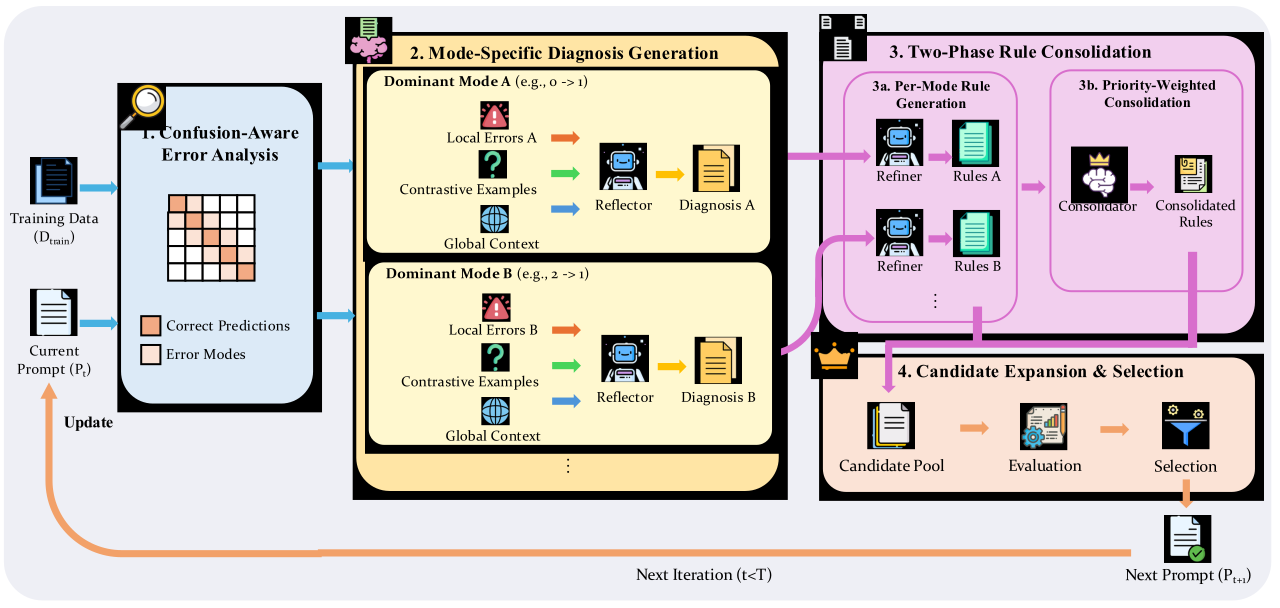
We propose CARO (Confusion-Aware Rubric for Optimization), a framework designed to overcome the limitations of aggregating feedback in automated rubric optimization. Existing methods often suffer from rule dilution, where conflicting error signals lead to vague instructions. To address this, CARO structurally decomposes the optimization problem using confusion matrices, treating grading errors not as random noise but as distinct, diagnosable modes. Our approach operates in three iterative phases: confusion-aware error analysis, mode-specific gradient generation, and priority-weighted rule consolidation.
4.1 Framework Overview
Figure 1 illustrates the complete CARO pipeline. To efficiently navigate the extensive search space of natural language prompts, CARO employs an iterative, minibatch-based optimization loop. In each iteration \(t\), rather than evaluating on the entire training set, which is computationally expensive and may obscure minority error patterns, we sample a focused subset of data (a minibatch) to estimate the current rubric’s performance. This iterative design allows the framework to progressively refine the rubric, addressing the most prominent error modes in early rounds before fine-tuning for edge cases.
The framework operates as a closed-loop optimization system with four interconnected components. Components 1–3 form the core optimization loop within a single round: (1) Confusion-Aware Error Analysis grades the minibatch and extracts structured error patterns; (2) Mode-Specific Gradient Generation produces targeted feedback for each confusion cell using a Reflector LLM; and (3) Two-Phase Rule Consolidation synthesizes per-mode rules into a unified rubric. These three components pass information sequentially within each optimization round. Component 4 (Candidate Selection and Sampling) operates at a different granularity as it governs the inter-round dynamics. It acts as a bridge between iterations by determining which candidate prompts survive to round \(t+1\) and constructing the specific training minibatch that will be used to evaluate it. This separation reflects the algorithmic structure: Components 1–3 generate candidate prompts within a single round, while Component 4 decides which candidates propagate across rounds and what data they will be evaluated on next. The dashed connection in the figure indicates this temporal decoupling.
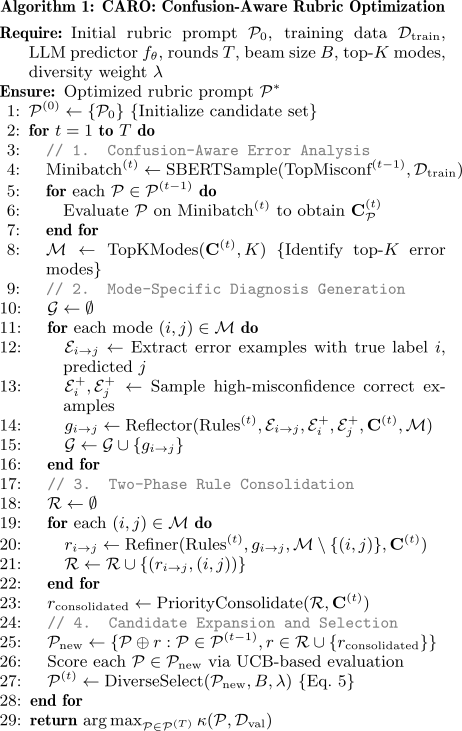
The complete procedure is summarized in Algorithm 1. Given an initial rubric prompt \(\mathcal {P}_0\), a training dataset \(\mathcal {D}_{\text {train}}\), and a LLM predictor \(f_\theta \), our objective is to iteratively optimize the prompt to minimize classification errors while ensuring stability across different score categories. The optimization process functions as a directed search. At each iteration \(t\), we first evaluate the current prompt on a minibatch to generate a confusion matrix \(\mathbf {C}^{(t)}\) (Algorithm 1, lines 4–7). From this matrix, we identify the top-\(K\) error modes, denoted as \(\mathcal {M} = \{(i_1, j_1), \dots , (i_K, j_K)\}\), ranked by frequency (line 8). Unlike standard methods that aggregate these errors, CARO generates distinct gradients for each mode (lines 10–16), which are subsequently consolidated into coherent rule updates (lines 18–23). This cycle repeats until convergence or a maximum step count \(T\) is reached.
Reflector Prompt for Mode \((0 \to 1)\) Confusion
[GLOBAL CONTEXT]
| True\(\backslash \)Pred | 0 | 1 | 2 |
| 0 | 6 | 25 | 7 |
| 1 | 0 | 9 | 10 |
| 2 | 0 | 0 | 7 |
| Example 1: “They understand it partially because I understand what they are doing but I would show them that setting it up as a proportion makes more sense.” |
|---|
| True: 0 Pred: 1 Reasoning: Teacher acknowledges some understanding but lacks specific analysis... |
| Example 2: “His explanation doesn’t really refer to the equivalent ratios. Although the actual work seems to show he has some understanding.” |
| True: 0 Pred: 1 Reasoning: Vague acknowledgment without depth... |
|
Correctly Classified as 0 | Correctly Classified as 1 |
|---|---|
| “Student A has a limited understanding because he based his answer on the dollar amount.” | “The student looked at price versus amount to find the unit rate.” |
| \(\rightarrow \) Incorrect/generic analysis | \(\rightarrow \) Procedural description of student work |
________________________________________________________________________________________________________________
[TASK] Analyze WHY the \(0 \to 1\) confusion occurs. Identify misleading patterns and propose rule fixes.
| Dataset | Domain | #Samples | Scores |
|---|---|---|---|
| \(\mathcal {D}_I\) | Interaction | 252 | {0,1} |
| \(\mathcal {D}_T\) | Teacher Education | 224\(\sim \)236 | {0,1,2} |
| \(\mathcal {D}_E\) | Elementary | 199\(\sim \)434 | {0,1,2,3,4} |
| Type | Task | Naive | GradeOpt | CARO
| |||
|---|---|---|---|---|---|---|---|
| Acc | \(\kappa \) | Acc | \(\kappa \) | Acc | \(\kappa \) | ||
| KSMT | T1 | 0.40 | 0.20 | 0.61 | 0.41 | 0.67 | 0.47 |
| KSMT | T2 | 0.58 | 0.42 | 0.74 | 0.61 | 0.79 | 0.69 |
| KSMT | T3 | 0.39 | 0.09 | 0.51 | 0.25 | 0.55 | 0.30 |
| KSMT | Avg | 0.46 | 0.24 | 0.62 | 0.42 | 0.67 | 0.49 |
| KMT | T4 | 0.30 | 0.05 | 0.55 | 0.28 | 0.76 | 0.57 |
| KMT | T5 | 0.59 | 0.28 | 0.60 | 0.31 | 0.74 | 0.46 |
| KMT | T6 | 0.68 | 0.44 | 0.76 | 0.58 | 0.76 | 0.59 |
| KMT | Avg | 0.52 | 0.26 | 0.64 | 0.39 | 0.75 | 0.54 |
| KT | T7 | 0.45 | 0.29 | 0.74 | 0.60 | 0.77 | 0.65 |
| KT | T8 | 0.60 | 0.34 | 0.70 | 0.48 | 0.72 | 0.52 |
| KT | Avg | 0.52 | 0.32 | 0.72 | 0.54 | 0.75 | 0.59 |
| Overall | Avg | 0.51 | 0.27 | 0.65 | 0.44 | 0.72 | 0.53 |
| Category | Naive | GradeOpt | CARO
| |||
|---|---|---|---|---|---|---|
| Acc | \(\kappa \) | Acc | \(\kappa \) | Acc | \(\kappa \) | |
| 1 | 0.94 | 0.79 | 0.96 | 0.84 | 0.98 | 0.92 |
| 2 | 0.86 | 0.71 | 0.88 | 0.76 | 0.93 | 0.87 |
| 3 | 0.82 | 0.52 | 0.85 | 0.61 | 0.95 | 0.89 |
| 4 | 0.52 | 0.19 | 0.64 | 0.36 | 0.81 | 0.62 |
| 5 | 0.62 | 0.18 | 0.95 | 0.72 | 0.96 | 0.78 |
| 6 | 0.42 | 0.03 | 0.73 | 0.09 | 0.87 | 0.21 |
| 7 | 0.77 | 0.11 | 0.95 | 0.48 | 0.97 | 0.54 |
| 8 | 0.22 | 0.03 | 0.44 | 0.04 | 0.74 | 0.12 |
| 9 | 0.15 | -0.04 | 0.27 | 0.01 | 0.90 | -0.02 |
| 10 | 0.42 | 0.14 | 0.72 | 0.41 | 0.82 | 0.47 |
| 11 | 0.60 | 0.14 | 0.90 | 0.50 | 0.94 | 0.64 |
| Avg | 0.58 | 0.25 | 0.75 | 0.43 | 0.90 | 0.55 |
| Dataset | Naive | GradeOpt | CARO
| |||
|---|---|---|---|---|---|---|
| Acc | \(\kappa \) | Acc | \(\kappa \) | Acc | \(\kappa \) | |
| \(\mathcal {D}_I\) (avg) | 0.58 | 0.25 | 0.75 | 0.43 | 0.90 | 0.55 |
| \(\mathcal {D}_T\) (avg) | 0.51 | 0.27 | 0.65 | 0.44 | 0.72 | 0.53 |
| \(\mathcal {D}_E\) (avg) | 0.44 | 0.14 | 0.71 | 0.54 | 0.73 | 0.59 |
| Overall | 0.51 | 0.22 | 0.70 | 0.47 | 0.78 | 0.56 |
| Dataset | Per-Mode | Consolidated | Best \(\kappa \) |
|---|---|---|---|
| \(\mathcal {D}_I\) | 93.9% | 6.1% | Per-Mode |
| \(\mathcal {D}_T\) | 91.7% | 8.3% | Per-Mode |
| \(\mathcal {D}_E\) | 93.3% | 6.7% | Per-Mode |
| Avg | 93.0% | 7.0% | - |
| Method | Rounds | API Calls | Est. Cost |
|---|---|---|---|
| GradeOpt | 6 | \(\sim \)40,000 | \(\sim \)$5 |
| CARO | 6 | \(\sim \)8,000 | \(\sim \)$2 |
| Reduction | – | 80% | 60% |
5.4 Qualitative Analysis
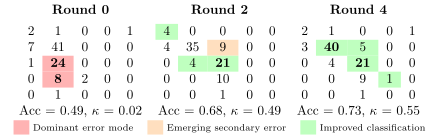
Case Study: Iterative Error Resolution on T5 (\(\mathcal {D}_E\))We illustrate CARO’s “diagnosis-and-repair” pipeline through a detailed case study on T5 (\(\mathcal {D}_E\)), which assesses elementary students’ understanding of how a Peregrine Falcon perceives a rock pigeon through a four-step light perception process (light travels to pigeon \(\to \) reflects off pigeon \(\to \) enters falcon’s eyes \(\to \) brain processes images). The task uses a 5-point ordinal scale \(\{0,1,2,3,4\}\) where Score 2 requires mentioning 1–2 steps, while Score 1 is reserved for responses containing no accurate steps. Figure 7 traces the confusion matrix evolution across optimization rounds, revealing how CARO systematically resolves cascading error patterns.
Round 0: Identifying the Dominant Mode. The initial classifier exhibits severe collapse toward Score 1, with the \(2 \to 1\) cell containing 24 errors (53% of all misclassifications, highlighted in red). Analysis reveals that responses mentioning partial steps, such as “the light source is the sun and the light travels to the eye and that’s how the falcon can see the pigeon”, were incorrectly penalized for omitting steps rather than credited for partial understanding. A secondary \(3 \to 1\) pattern (8 errors) compounds this collapse, resulting in zero correct predictions for Scores 2–4 and a near-chance \(\kappa = 0.02\).
Round 2: Resolving the Primary Collapse. CARO’s Reflector diagnoses the root cause: the original rubric lacks explicit guidance for recognizing partial scientific understanding. The generated rule states: “If a response includes at least one correct element related to the four steps (e.g., light traveling, reflecting, or entering the eyes), classify as Score 2, provided it does not contain entirely irrelevant information.” As shown in the Round 2 matrix, this intervention reduces \(2 \to 1\) errors from 24 to 4 (\(-83\%\), green), while correct Score-2 predictions increase from 0 to 21. Class 0 achieves perfect classification (orange). However, the fix reveals an emergent secondary pattern: \(1 \to 2\) confusion (9 errors, orange) as the model now over-awards partial credit to responses lacking any valid steps.
Round 4: Addressing the Secondary Mode. CARO shifts focus to the \(1 \to 2\) over-correction, introducing a discriminative rule: “Responses must include at least one identifiable step describing light’s journey; vague statements about ‘seeing’ without mechanistic detail remain Score 1.” The Round 4 matrix shows this refinement reduces \(1 \to 2\) errors from 9 to 5 while improving Score-1 correct predictions to 40 (up from 35). Crucially, the \(2 \to 1\) gains are preserved (4 errors), and Score 3 achieves its first correct prediction. The final \(\kappa = 0.55\) reflects balanced diagonal improvement across all classes.
This progression exemplifies CARO’s core mechanism. Instead of treating error reduction as a single, monolithic task, the framework isolates specific confusion patterns within the matrix. This decomposition turns a complex optimization challenge into a sequential and interpretable repair process. Crucially, this step-by-step approach ensures that corrections for one error type build upon previous improvements without causing regression in other classes.
6. DISCUSSION
The experimental results demonstrate that the Confusion-Aware Rubric Optimization (CARO) framework significantly advances the state of automated grading by addressing the structural inefficiencies of prior prompt optimization methods. While existing frameworks such as GradeOpt rely on aggregating heterogeneous error signals, our findings confirm that such aggregation leads to rule dilution, where the optimizer struggles to satisfy conflicting constraints simultaneously. By decomposing the optimization context into distinct error modes via the confusion matrix, CARO transforms the complex prompt refinement into a series of targeted repairs.
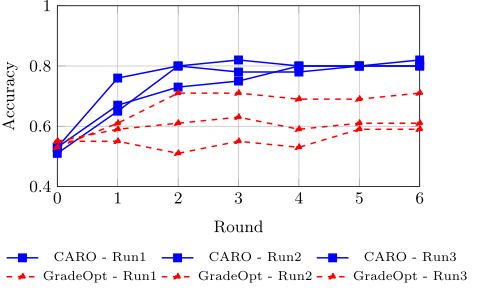
A primary implication of this study is the relationship between optimization specificity and efficiency. Our analysis reveals that CARO achieves superior performance with approximately 60% lower computational costs compared to baseline methods. This efficiency stems from the mode-specific gradient generation, which prevents the optimization process from cycling through redundant rule changes. Instead of requiring extensive exploration to find a marginally better prompt, the structured diagnosis allows the model to identify and resolve dominant failure patterns, such as the confusion between partial and complete understanding, with the first few iterations. This suggests that for ordinal grading tasks, structural error analysis (with confusion matrix) is a more resource-efficient method for improvement than simply increasing the volume of feedback or the size of the optimizer model.
Furthermore, the pedagogical utility of automated assessment relies heavily on interpretability and trust. This distinguishes our approach from traditional automated grading methods, such as latent semantic analysis or BERT-based fine-tuning, which process inputs through high-dimensional vectors and lack visibility into the decision-making process. Unlike these earlier supervised pipelines that function as black-box systems, CARO optimizes the natural language rubric itself. The resulting prompts contain explicit reasoning traces and priority-weighted decision rules. This transparency allows educators to validate the grading criteria before deployment, ensuring that automated system aligns with instructional goals.
Despite these strengths, there are limitations to consider. The
current framework relies on the capability of the backbone LLM
to self-reflect and generate diagnostic feedback. While our
experiments utilized GPT-4o-mini effectively, the performance of
CARO on smaller, open-source models remain an area for future
investigation.
7. CONCLUSION
This study introduced Confusion-Aware Rubric Optimization (CARO), a novel framework designed to bridge the alignment gap between expert grading criteria and LLM logic. By identifying that grading errors are not random noise but structured clusters, we developed a method that replaces aggregate feedback with mode-specific diagnosis and repair. Through the systematic decomposition of confusion matrices, CARO isolates specific misclassification patterns and generates targeted rule patches that resolve ambiguities without degrading global performance.
Our empirical evaluation across three distinct educational datasets confirms that CARO significantly outperforms state-of-the-art prompt optimization methods in both accuracy and inter-rater reliability. Critically, the framework achieves these gains while reducing computational overhead, offering a scalable solution for high-quality formative assessment. By providing a transparent, efficient, and precise method for rubric refinement, CARO represents a substantial step reliable and scalable automated feedback in complex learning environments.
8. ACKNOWLEDGMENTS
This work was supported in part by the U.S. National Science Foundation under Grant Nos. 1813760, 2405483, 2234015, CNS-2321416, IIS-2212032, IIS-2212144, IIS-2504089, DUE-2234015, CNS-2246050, DRL-2405483, and IOS-2035472; the U.S. Department of Education under Grant No. S411B240024; the Gates Foundation; the Michigan Department of Agriculture and Rural Development; the U.S. Department of Commerce; Amazon Faculty Award; Meta; NVIDIA; Microsoft; and Snap Inc.
References
- Y. Attali and J. Burstein. Automated essay scoring with e-rater® v. 2. The Journal of Technology, Learning and Assessment, 2006.
- P. Black and D. Wiliam. Assessment and classroom learning. Assessment in Education: principles, policy & practice, 1998.
- I. Chamieh, T. Zesch, and K. Giebermann. Llms in short answer scoring: Limitations and promise of zero-shot and few-shot approaches. In Proceedings of the 19th workshop on innovative use of nlp for building educational applications (bea 2024), pages 309–315, 2024.
- Z. Chen and T. Wan. Grading explanations of problem-solving process and generating feedback using large language models at human-level accuracy. Physical Review Physics Education Research, 21(1):010126, 2025.
- Y. Chu, P. He, H. Li, H. Han, K. Yang, Y. Xue, T. Li, J. Krajcik, and J. Tang. Enhancing llm-based short answer grading with retrieval-augmented generation. arXiv preprint arXiv:2504.05276, 2025.
- Y. Chu, H. Li, K. Yang, H. Shomer, Y. Copur-Gencturk, L. Kaldaras, K. Haudek, J. Krajcik, N. Shin, H. Liu, and J. Tang. A llm-powered automatic grading framework with human-level guidelines optimization. In Proceedings of the 18th International Conference on Educational Data Mining, pages 31–41. International Educational Data Mining Society, July 2025.
- J. Cohen. A coefficient of agreement for nominal scales. Educational and psychological measurement, 20(1):37–46, 1960.
- Y. Copur-Gencturk and T. Tolar. Mathematics teaching expertise: A study of the dimensionality of content knowledge, pedagogical content knowledge, and content-specific noticing skills. Teaching and Teacher Education, 114:103696, 2022.
- J. Devlin, M.-W. Chang, K. Lee, and K. Toutanova. Bert: Pre-training of deep bidirectional transformers for language understanding. In Proceedings of the 2019 conference of the North American chapter of the association for computational linguistics: human language technologies, volume 1 (long and short papers), pages 4171–4186, 2019.
- S. Dikli. An overview of automated scoring of essays. The Journal of Technology, Learning and Assessment, 5(1), 2006.
- P. W. Foltz, D. Laham, and T. K. Landauer. The intelligent essay assessor: Applications to educational technology. Interactive Multimedia Electronic Journal of Computer-Enhanced Learning, 1(2):939–944, 1999.
- S. Haller, A. Aldea, C. Seifert, and N. Strisciuglio. Survey on automated short answer grading with deep learning: from word embeddings to transformers. arXiv preprint arXiv:2204.03503, 2022.
- J. Hattie and H. Timperley. The power of feedback. Review of educational research, 2007.
- L. Jiang and N. Bosch. Short answer scoring with gpt-4. In Proceedings of the Eleventh ACM Conference on Learning@ Scale, pages 438–442, 2024.
- L. Kaldaras, H. Akaeze, and J. Krajcik. Developing and validating next generation science standards-aligned learning progression to track three-dimensional learning of electrical interactions in high school physical science. Journal of Research in Science Teaching, 58(4):589–618, 2021.
- O. Khattab, A. Singhvi, P. Maheshwari, Z. Zhang, K. Santhanam, S. Haq, A. Sharma, T. T. Joshi, H. Moazam, H. Miller, et al. Dspy: Compiling declarative language model calls into state-of-the-art pipelines. In The Twelfth International Conference on Learning Representations, 2024.
- J. R. Landis and G. G. Koch. The measurement of observer agreement for categorical data. biometrics, pages 159–174, 1977.
- C. Leacock and M. Chodorow. C-rater: Automated scoring of short-answer questions. Computers and the Humanities, 37(4):389–405, 2003.
- S. A. Livingston. Constructed-response test questions: Why we use them; how we score them. r&d connections. number 11. Educational Testing Service, 2009.
- E. Mayfield and A. W. Black. Should you fine-tune bert for automated essay scoring? In Proceedings of the fifteenth workshop on innovative use of NLP for building educational applications, pages 151–162, 2020.
- M. Mohler and R. Mihalcea. Text-to-text semantic similarity for automatic short answer grading. In Proceedings of the 12th Conference of the European Chapter of the ACL (EACL 2009), pages 567–575, 2009.
- OECD. Results from talis 2024: The state of teaching, 2025.
- R. Pryzant, D. Iter, J. Li, Y. T. Lee, C. Zhu, and M. Zeng. Automatic prompt optimization with" gradient descent" and beam search. arXiv preprint arXiv:2305.03495, 2023.
- N. Reimers and I. Gurevych. Sentence-bert: Sentence embeddings using siamese bert-networks. arXiv preprint arXiv:1908.10084, 2019.
- V. J. Shute. Focus on formative feedback. Review of educational research, 2008.
- A. Vaswani, N. Shazeer, N. Parmar, J. Uszkoreit, L. Jones, A. N. Gomez, Ł. Kaiser, and I. Polosukhin. Attention is all you need. Advances in neural information processing systems, 30, 2017.
- C. Yang, X. Wang, Y. Lu, H. Liu, Q. V. Le, D. Zhou, and X. Chen. Large language models as optimizers. In The Twelfth International Conference on Learning Representations, 2023.
- X. Zhang, J. Cao, C. You, and D. Ding. Why prompt design matters and works: A complexity analysis of prompt search space in llms. In Proceedings of the 63rd Annual Meeting of the Association for Computational Linguistics (Volume 1: Long Papers), pages 32525–32555, 2025.
- Y. Zhou, A. I. Muresanu, Z. Han, K. Paster, S. Pitis, H. Chan, and J. Ba. Large language models are human-level prompt engineers. In The eleventh international conference on learning representations, 2022.
© 2026 Copyright is held by the author(s). This work is distributed under the Creative Commons Attribution-NonCommercial-NoDerivatives 4.0 International (CC BY-NC-ND 4.0) license.