ABSTRACT
With growing interest in applying artificially intelligent agents to collaborative learning settings, we are challenged to identify meaningful moments for these agents to intervene. I propose moments of disagreement within groups to be pivotal - that is, the interaction can lead to learning gains or disruption depending on how they are handled. With that in mind, I plan to run user studies over a short group task to explore a baseline turn-based intervention policy compared to a disagreement-driven intervention policy. While these moments are nuanced, this study will provide some initial insights into a specific, educationally grounded, and explainable intervention policy during a group task conflict.
Keywords
1. INTRODUCTION TO THE PROBLEM
Collaborative learning is a well-studied area in education, with growing opportunity to apply artificially intelligent agents as helpers [1, 6, 7, 19]. However, as we develop the necessary architectures to handle multimodal, multiparty, and in-person interactions, we are still left with a gap between the technology and educationally grounded human-AI interaction [6]. One question we must ground in the learning sciences is when to intervene, if at all. A closely related question is how conflict is handled in small groups. In a previous article, Rummel et al. contrasted two possible extremes for the future of AI in collaborative work: a dystopian future and a utopian future [17]. Notably, the two paths both included group conflict and dialogue policies. The dystopian scenerio described a pair with frequent conflict, frustrating interventions, and unexplainable outcomes from the AI. In the utopian scenerio, however, the dialogue policy was explainable, and conflict was treated as a nuanced situation, with helpful interventions aimed at productive conversation [17]. While both futures are still far off, I aim to explore the intersection of dialogue policy and conflict management in small group tasks. Previous work has explored human-centered dialogue policies for collaborative learning [4, 6], including wizard-of-oz analysis to inform dialogue policy and real-time, state-based dialogue policies. For example, in [6], group states were automatically classified and used to determine interventions. One outcome of this study was showcasing that active negotiations could contribute to unproductive perseverence; that is, when students were addressing task conflict, they could get stuck. While this was one consideration in their dialogue policy, I am interested in isolating this aspect and diving deeper into its impact on collaborative outcomes.
2. PROPOSED FRAMING AND SOLUTION
Collaborative work often requires progress toward common ground [19, 26]. However, if task conflict arises, it can create an obstacle which requires negotiation to resolve [7, 8]. While previous work has shown mixed outcomes, with task conflict sometimes being a positive learning event [8] and sometimes a negative learning event [9, 11], the literature seems to indicate that the difference in these pivotal moments is how the conflict is handled [9, 12, 20, 23]. With this in mind, I propose that disagreement can serve as a signal to intervene. In particular, disagreements which are not being resolved or are escalating may require assistance from an external party [3, 6, 7]. Disagreement, for this paper, refers to a conflict in which we cannot reach common ground with the current task propositions [26]. For example, if one student believes the answer is A, and another student believes the answer is not A, they must resolve this disagreement if common ground is needed for the task. To explore this specific dialogue policy, I will implement user studies with a real-time, multimodal common ground tracking system [21] with the addition of interventions.
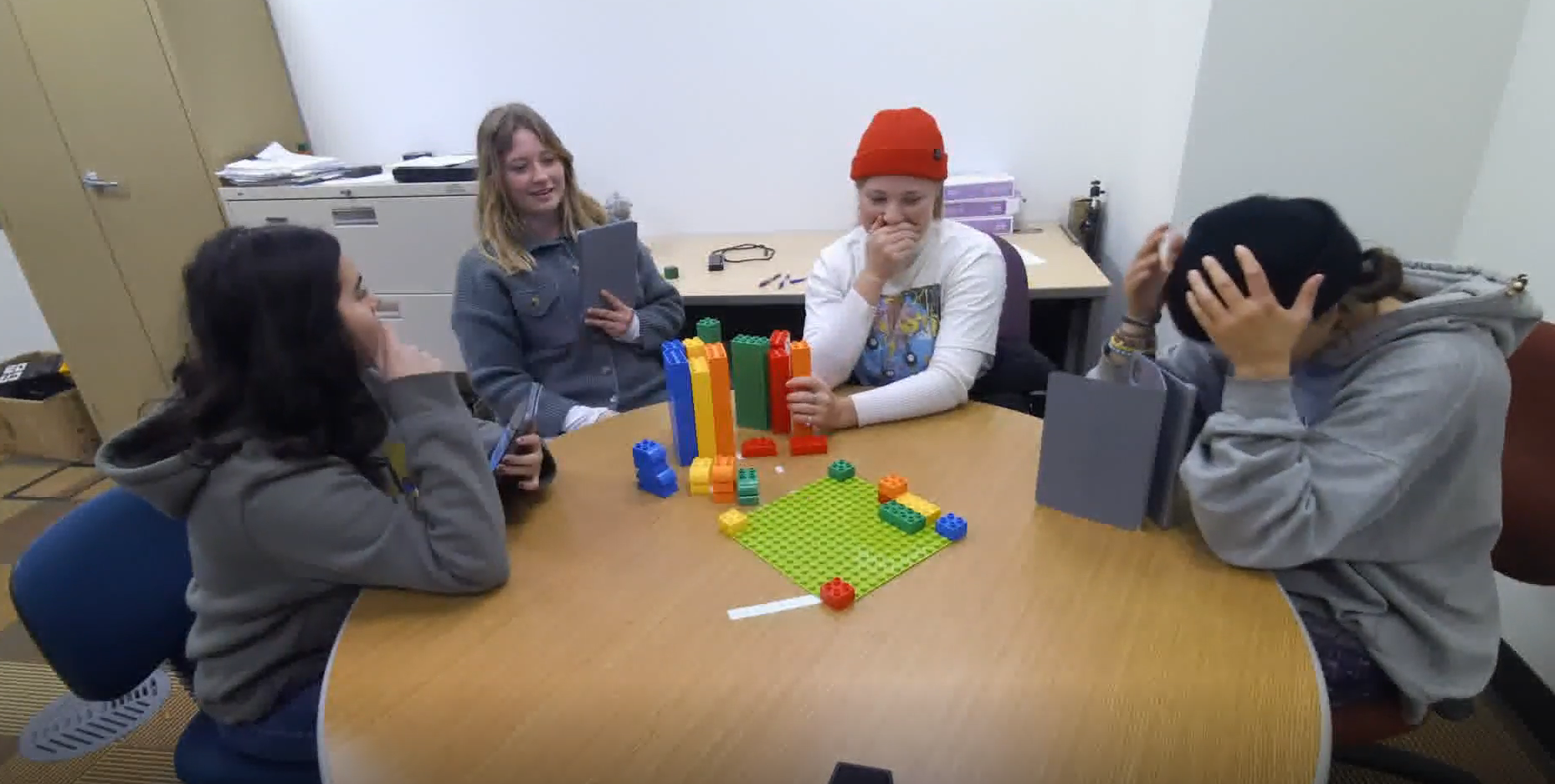
DPIP TaskFor this project, groups of four will complete a Distributed Partial Information Puzzle (DPIP) [25], wherein participants work together to recreate a target Lego structure. Following the jigsaw approach used in [6], three of the participants have unique information and must work together to piece their knowledge into one combined solution (in my case, the Lego structure). The remaining participant acts as the builder, constructing the structure but without any information to start with. This task requires collaboration between each team member, as well as negotiating unique perspectives to reach the final outcome. In this task, disagreement naturally arises as participants attempt to orient together and give directions to the builder. An example of this can be seen in Fig 2. The group thought they were correctly completing the task, but they came to an impass when there was a conflict between two members’ views. While one participant (P4) saw a red block in a specific location, another participant (P2) believed it should have been an orange block. The builder places a red, removes it, and places an orange, at which point P4 rests her head in her hands as a sign of confusion. At this point, the solution is that the participants are actually referring to two separate corners; each person is correct, but their beliefs about their wall orientation needs to be adjusted. I propose moments such as this one to be potentially helpful moments for an agent to intervene.
| P4 | And there’s two of [red]. |
|---|---|
| P2 | I have orange on top of the red. |
| P4 | Orange? |
| P4 | Oh no. |
| P4 | That’s not right for me. |
Intervention AgentsThe interventions will be provided as speech and on-screen text to the group. Interventions will come from one of three fine-tuned versions of Meta-Llama-3-8B-Instruct: Identity Preference Optimization (IPO) [2], Proximal Policy Optimization (PPO) [18], or the Frictional Agent Alignment Framework (FAAF) [15]. IPO and PPO are well-known fine-tuning techniques; IPO is an offline contrastive approach, while PPO is an online reinforcement learning approach. FAAF is a more recent approach which fine-tunes the model to act as a collaborator in a frictive state, which makes it more aligned with the goal of the intervention.
Dialogue Policy ConditionsI will compare two dialogue policies. My baseline condition is to provide an intervention every seven utterances. This was based on a qualitative exploration between five and ten utterances, with five being too frequent and ten being too far apart. This baseline provides an explainable but naive comparison, with no meaningful or education-based policy; it is simply rule-based. The second condition provides an intervention when a disagreement is detected in the dialogue by a large language model. This condition explores the specific challenge of conflict management in collaborative learning. It is also grounded in existing literature on collaborative learning, which has found conflict to be impactful - either positively or negatively - on the group [8].
EvaluationI will evaluate the outcomes based on three dimensions; group speed, correctness of final structure, and user experience. The group speed will simply consider the time taken to complete the task. Correctness of the structure will compare the group’s final structure with the target structure. User experience will include a self-report survey [13, 14] after completing the task as well as behavioral signals for user engagement with the agent. Signals will include verbal and nonverbal items such as visual attention toward the agent and speaking over the agent [5].
LLM Disagreement DetectionBesides the user outcomes, I also must evaluate the performance of the system on the detection task. The task will be detecting disagreement in small group dialogues. One additional challenge in this task is that disagreements are often expressed implicitly through contradiction rather than directly stating disagreement [24]. Because of this, I aim to leverage the interpretive power in LLMs. To evaluate LLMs on this task, I will test multiple models on various datasets. I will explore the model’s performance on the Delidata dataset [10]. This is a dataset of small groups performing the Wason card selection task, a well-known reasoning task [22], and includes labels for explicit group disagreement. I will also label a subset of this dataset for implicit disagreement in order to compare performance on both types of expression. Further, I will use a synthetic version of the DPIP task presented in [16]. These provide some initial evaluation on the LLM performance of detecting disagreement, which will serve as the gate for my proposed dialogue policy exploration.
3. EXPECTED CONTRIBUTIONS
This research will offer insight into the impact of intervening during disagreement as a dialogue policy. This builds off of prior work exploring group state dialogue policy, which considers unproductive negotiations as a group state [6], but isolates this one aspect for further investigation. This also provides a study outline for other specific rule-based and educationally-grounded dialogue policy explorations. As we move toward AI assistants in collaborative learning, it is critical to have explainable and grounded dialogue policy. Disagreement is an especially interesting moment because of its potential to negatively or positively impact the group; this makes it worth investigating further on its own. It is also a timely challenge, as we now have live multimodal and multiparty systems. It’s important to bridge the gap between the existence of the system and years of foundational learning sciences outlining the challenges which arise in collaborative settings. I propose a human-centered AI approach, which focuses on one proposed moment of intervention known to be pivotal in collaboration and tests it in a user study with a live agent system.
4. REFERENCES
- J. Andrews-Todd and C. M. Forsyth. Exploring social and cognitive dimensions of collaborative problem solving in an open online simulation-based task. Computers in Human Behavior, 104:105759, Mar. 2020.
- M. G. Azar, Z. D. Guo, B. Piot, R. Munos, M. Rowland, M. Valko, and D. Calandriello. A general theoretical paradigm to understand learning from human preferences. In International Conference on Artificial Intelligence and Statistics, pages 4447–4455. PMLR, 2024.
- C. De Kock and A. Vlachos. I Beg to Differ: A study of constructive disagreement in online conversations. In Proceedings of the 16th Conference of the European Chapter of the Association for Computational Linguistics: Main Volume, pages 2017–2027, 2021.
- I. Dey, E. Doherty, R. Zhang, N. Hoang, J. B. Bush, L. Hirshfield, and S. Puntambekar. Examining support moments with a conversational ai partner. In Proceedings of the 18th International Conference on Computer-Supported Collaborative Learning-CSCL 2025, pp. 169-177. International Society of the Learning Sciences, 2025.
- I. Dey, S. Puntambekar, R. Li, D. Gengler, R. Dickler, L. M. Hirshfield, and N. Krishnaswamy. The nice framework: analyzing students’ nonverbal interactions during collaborative learning. In Pre-conference workshop on collaboration analytics at 13th international learning analytics and knowledge conference (lak 2023), 2023.
- E. Doherty, E. M. Perkoff, S. von Bayern, R. Zhang, I. Dey, M. Bodzianowski, S. Puntambekar, and L. Hirshfield. Piecing together teamwork: A responsible approach to an LLM-based educational jigsaw agent. In Proceedings of the 2025 CHI Conference on Human Factors in Computing Systems, pages 1–17, 2025.
- A. C. Graesser, S. M. Fiore, S. Greiff, J. Andrews-Todd, P. W. Foltz, and F. W. Hesse. Advancing the Science of Collaborative Problem Solving. Psychological Science in the Public Interest, 19(2):59–92, Nov. 2018. Publisher: SAGE Publications Inc.
- K. A. Jehn. A qualitative analysis of conflict types and dimensions in organizational groups. Administrative science quarterly, pages 530–557, 1997. Publisher: JSTOR.
- K. A. Jehn, L. Greer, S. Levine, and G. Szulanski. The effects of conflict types, dimensions, and emergent states on group outcomes. Group decision and negotiation, 17(6):465–495, 2008. Publisher: Springer.
- G. Karadzhov, T. Stafford, and A. Vlachos. DeliData: A dataset for deliberation in multi-party problem solving. Proceedings of the ACM on Human-Computer Interaction, 7(CSCW2):1–25, 2023. Publisher: ACM New York, NY, USA.
- J. Lahti, A. Eteläpelto, and S. Siitari. Conflict as a challenge to productive learning during long-term collaboration. Learning to Collaborate: Collaborating to Learn, Nova Scotia Publishers, New York, NY, 2004.
- D. Lee, Y. Huh, and C. M. Reigeluth. Collaboration, intragroup conflict, and social skills in project-based learning. Instructional science, 43:561–590, 2015. Publisher: Springer.
- S. A. Mannan, P. Hansen, V. P. Vimal, H. N. Davies, P. DiZio, and N. Krishnaswamy. Combating spatial disorientation in a dynamic self-stabilization task using ai assistants. In Proceedings of the 12th International Conference on Human-Agent Interaction, pages 113–122, 2024.
- B. M. Muir. Trust in automation: Part i. theoretical issues in the study of trust and human intervention in automated systems. Ergonomics, 37(11):1905–1922, 1994.
- A. Nath, C. Graff, A. Bachinin, and N. Krishnaswamy. Frictional agent alignment framework: Slow down and don’t break things. In Proceedings of the 63rd Annual Meeting of the Association for Computational Linguistics (Volume 1: Long Papers), pages 11042–11089, 2025.
- A. Nath, H. VanderHoeven, and N. Krishnaswamy. Craft: Grounded multi-agent coordination under partial information. arXiv preprint arXiv:2603.25268, 2026.
- N. Rummel, E. Walker, and V. Aleven. Different futures of adaptive collaborative learning support. International Journal of Artificial Intelligence in Education, 26(2):784–795, 2016. Publisher: Springer.
- J. Schulman, F. Wolski, P. Dhariwal, A. Radford, and O. Klimov. Proximal policy optimization algorithms. arXiv preprint arXiv:1707.06347, 2017.
- C. Sun, V. J. Shute, A. Stewart, J. Yonehiro, N. Duran, and S. D’Mello. Towards a generalized competency model of collaborative problem solving. Computers & Education, 143:103672, 2020.
- M.-H. Tsai and C. Bendersky. The pursuit of information sharing: Expressing task conflicts as debates vs. disagreements increases perceived receptivity to dissenting opinions in groups. Organization Science, 27(1):141–156, 2016. Publisher: Informs.
- H. VanderHoeven, B. Bhalla, I. Khebour, A. C. Youngren, V. Venkatesha, M. Bradford, J. Fitzgerald, C. Mabrey, J. Tu, Y. Zhu, et al. Trace: Real-time multimodal common ground tracking in situated collaborative dialogues. In Proceedings of the 2025 Conference of the Nations of the Americas Chapter of the Association for Computational Linguistics: Human Language Technologies (System Demonstrations), pages 40–50, 2025.
- P. C. Wason. Reasoning about a Rule. Quarterly Journal of Experimental Psychology, 20(3):273–281, Aug. 1968. Publisher: SAGE Publications.
- L. R. Weingart, K. A. Jehn, and K. L. Krueger. Manage intrateam conflict through collaboration. Principles of Organizational Behavior: The Handbook of Evidence-Based Management 3rd Edition, pages 403–427, 2023. Publisher: Wiley Online Library.
- J. Zhou, C. E. Hmelo-Silver, Z. Ryan, C. Stiso, D. Murphy, J. Danish, C. A. Chinn, and R. G. Duncan. Disagreeing softly: Supporting students in managing disagreement in peer critique: Disagreeing softly: Supporting students in managing disagreement in peer critique. International Journal of Computer-Supported Collaborative Learning, 20(2):249–282, 2025.
- Y. Zhu, M. Bradford, K. Lai, T. Obiso, V. Venkatesha, J. Pustejovsky, and N. Krishnaswamy. Distributed partial information puzzles: Examining common ground construction under epistemic asymmetry. arXiv preprint arXiv:2603.05450, 2026.
- Y. Zhu, H. VanderHoeven, K. Lai, M. Bradford, C. Tam, I. Khebour, R. Brutti, N. Krishnaswamy, and J. Pustejovsky. Modeling Theory of Mind in Multimodal HCI. In International Conference on Human-Computer Interaction, pages 205–225. Springer, 2024.
© 2026 Copyright is held by the author(s). This work is distributed under the Creative Commons Attribution-NonCommercial-NoDerivatives 4.0 International (CC BY-NC-ND 4.0) license.